
Disposable PPE Head-to-Toe: Caps, Coveralls and Shoe Covers
A coherent disposable personal protective equipment (PPE) program is more than a box of masks. In controlled environments such as operating theatres, isolation wards, cleanrooms, food-processing plants, and laboratories, contamination control depends on covering the body from head to toe with the right barrier at every level. For distributors and hospital procurement teams, the opportunity is to supply that complete system rather than isolated commodities. This guide builds a head-to-toe disposable PPE range using the JPS Medical portfolio: surgical and bouffant headwear, protective coveralls, shoe and boot covers, and scrub suits, with the material science, sizing logic, and procurement controls a serious importer needs.
Why a Head-to-Toe Program Outperforms Piecemeal Buying
Contamination does not respect product boundaries. A facility that buys an excellent coverall but pairs it with a leaking shoe cover, or a sterile gown with a shedding cap, has a weak link that defeats the whole protocol. Building a matched program means specifying compatible barrier levels, consistent non-woven materials, and coordinated sizing so the gear works as a system. It also simplifies procurement: a single ISO 13485 manufacturer supplying caps, coveralls, footwear, and scrubs gives you one audit trail, one set of certificates, and one consolidated container instead of fragmented sourcing across vendors of varying quality.
The logical way to plan the range is anatomically, from the head down. Each zone has its own dominant risk and its own established product solutions.
Headwear: Bouffant, Mob, Doctor and Surgical Caps
Head coverings contain hair and scalp shedding, which is a significant particulate and microbial source. The JPS Medical headwear line covers the common formats, and choosing between them is mostly about coverage and setting.
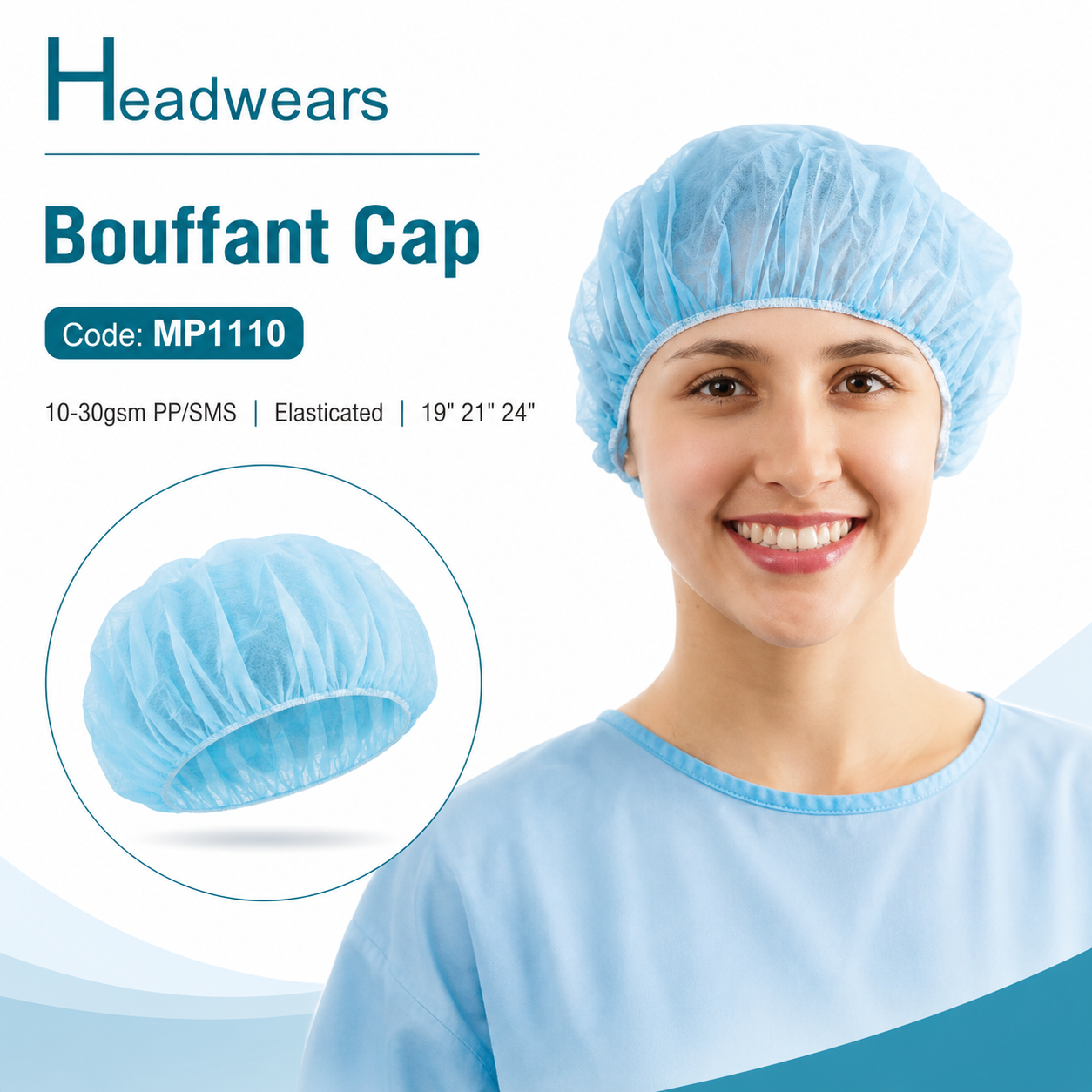
- Bouffant Cap (MP1110) is the gathered, balloon-shaped cap with a full elastic edge. It accommodates long hair and large head sizes and is the default for general clinical, laboratory, food, and visitor use. It is fast to don and economical at volume.
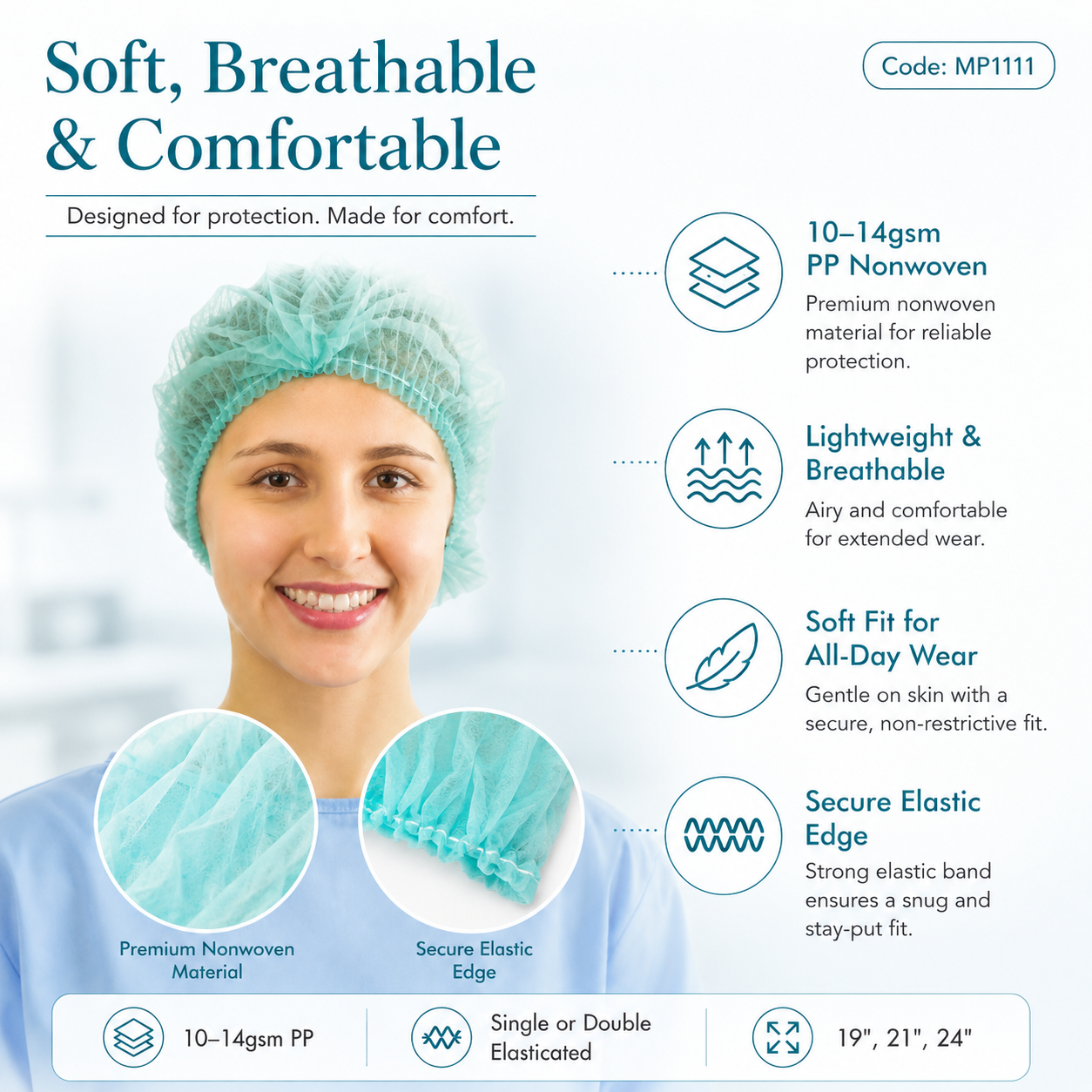
- Mob Cap (MP1111) is closely related, a pleated round cap with double or single elastic, widely used in food processing, pharmaceutical, and cleanroom entry, and for visitors. The double-elastic version gives a more secure fit.
- Doctor Cap (MP1116) is the tie-back style favored in surgical settings, offering a closer fit at the forehead and a tailored profile for clinicians who prefer it over a bouffant.
- Spunlace Surgical Cap (MP1103) is made from spunlace non-woven, which is softer, more absorbent at the brow, and lower-linting, making it well suited to the operating room where comfort and low particle shedding matter.
The material distinction is worth flagging in your specification. Most economy caps are spunbond polypropylene (PP), light and breathable. Spunlace (hydroentangled) fabric, as used in the MP1103, is softer and lower-linting, which is why it commands a premium in surgical headwear. Specify fabric type and grammage (grams per square meter, GSM) for every cap, because GSM is the single number that most affects perceived quality and cost.

Coveralls: Barrier Type, EN 14126 and Fabric Choice
The coverall is the core garment of body protection, and it is where the most important technical standards apply. The JPS Medical Protective Coverall (MP1920) and Medical Protective Coverall (MP1951) cover general industrial and medical-grade infection-control needs respectively. To buy these correctly, you must understand the European protective-clothing type classification and the biological-hazard standard.
Chemical protective clothing in the EU is graded into Types based on the EN standards that test against different challenge forms. The two most relevant to disposable medical and industrial coveralls are:
- Type 5 (EN ISO 13982-1): protection against airborne solid particulates (dry particles, dust).
- Type 6 (EN 13034): limited protection against light liquid splash and aerosols.
For infection control, the decisive standard is EN 14126, which specifies requirements and test methods for protective clothing against infective agents. A coverall carrying EN 14126 (often denoted with a "B" suffix on the Type, e.g. Type 5-B/6-B) has been tested as a barrier to biologically contaminated liquids, aerosols, and particles. A medical-grade coverall such as the MP1951 should be specified against EN 14126 when used for patient care or outbreak response. In the EU these garments are typically certified as Category III PPE under Regulation (EU) 2016/425, and where the product is also placed as a medical device, CE marking under the relevant route applies. Always obtain the EU type-examination certificate and test reports for the exact model and fabric.
Fabric construction governs the protection-versus-breathability trade-off:
- SMS (spunbond-meltblown-spunbond) is breathable and offers good particulate and light-splash protection at a comfortable weight, a common choice for Type 5/6 general use.
- Microporous film laminate (PE film bonded to non-woven) gives a stronger liquid and viral barrier, suited to higher-risk Type 5-B/6-B medical coveralls, at the cost of some breathability.
When specifying coveralls, confirm seam construction (serged, bound, stitched-and-taped), the Type rating with EN test references, EN 14126 status, hood and elastication design, zipper and storm-flap, and GSM. Taped seams are essential for any genuine liquid or biological barrier claim because an untaped stitched seam is a needle-hole leak path.
The most common specification mistake in coverall sourcing is buying on the word "Type 5" alone. Without the EN 14126 biological designation and taped seams, a Type 5 garment may stop dust but offers no validated barrier to infective liquids, which is exactly the hazard a hospital is buying it for.
Footwear: Shoe Covers and Non-Skid Options
Footwear covers close the bottom of the protective envelope and protect floors from tracked contamination. The JPS Medical line spans light to heavy duty:
- Shoe Cover (MP1510) is the standard non-woven PP overshoe with an elastic opening, economical for general clinical and visitor traffic.
- Non-Skid Shoe Cover (MP1511) adds an anti-slip sole treatment, an important safety feature on smooth theatre and cleanroom floors where a plain cover can be slippery.
- Plastic Shoe Cover (MP1530) is a polyethylene (PE) or CPE waterproof cover for wet environments and splash protection, where a non-woven cover would wet through.
The material choice maps to the hazard. Non-woven PP breathes and suits dry particulate control; PE/CPE is impervious and suits liquid and splash zones. For high-fluid procedures, longer boot covers (knee or thigh length) extend the barrier up the leg. Specify the length, the elastic or tie closure, GSM or film thickness in microns, and whether anti-slip is required, because the difference between a safe and a hazardous shoe cover on a wet floor is exactly that sole treatment.
Scrub Suits and Completing the System
The Scrub Suit (MP1421) provides the base clothing layer worn under or in place of reusable scrubs. Disposable scrub suits are valued where laundering is impractical, for visitors, temporary staff, isolation areas, and outbreak surge capacity. A two-piece top and trouser set in SMS or spunlace non-woven gives breathable comfort with low linting. Specify the fabric, GSM, color, size range, pocket configuration, and packaging. Because scrub suits are body-worn for extended periods, breathability and a soft hand feel are as important as barrier performance, which is why spunlace and lighter SMS fabrics are common here.
With headwear, coverall, footwear, and scrubs defined, the program is complete. The remaining specification decisions cut across all of them: sterility, sizing, and non-woven fabric grade.
Sterile Versus Non-Sterile
Most caps, shoe covers, and scrub suits are supplied non-sterile because they protect against, rather than contact, the sterile field. Where a sterile barrier is required, products are individually packaged and sterilized (commonly by ethylene oxide or gamma irradiation), and the sterile barrier packaging should be designed and validated to ISO 11607, the standard for packaging of terminally sterilized medical devices. Decide sterility per item and per use-case, and never assume; it materially changes price, packaging, lead time, and documentation.
Sizing and Fabric Grade
Headwear is usually one-size with elastic, but coveralls and scrub suits need a real size run (typically S to XXL or larger) keyed to height and chest measurements. Always obtain the supplier's size chart in centimeters and match it to your target population, since Asian-cut and Western-cut garments differ. For every non-woven item, GSM is the master quality variable: higher GSM means more material, more strength, and more cost, so specify it explicitly rather than accepting "standard."
| Zone | JPS product | Typical fabric | Key spec to define |
|---|---|---|---|
| Head | Bouffant MP1110 / Mob MP1111 | Spunbond PP | GSM, elastic, diameter |
| Head (surgical) | Doctor MP1116 / Spunlace MP1103 | Spunlace / PP | Tie vs elastic, GSM, linting |
| Body (general) | Protective Coverall MP1920 | SMS | Type 5/6, seams, GSM |
| Body (medical) | Medical Coverall MP1951 | Microporous laminate | EN 14126, taped seams |
| Feet | Shoe Cover MP1510 / MP1511 | Spunbond PP | Anti-slip sole, GSM |
| Feet (wet) | Plastic Shoe Cover MP1530 | PE / CPE | Film microns, length |
| Base layer | Scrub Suit MP1421 | SMS / spunlace | Size run, GSM, pockets |
Procurement, OEM and Certification Controls
Vetting a PPE supplier starts with the quality system and the certificates that match your destination market. Require an ISO 13485 quality management system, and for any product placed on the EU market obtain CE documentation under the correct route: PPE coveralls fall under Regulation (EU) 2016/425 (Category III for biological hazards) with an EU type-examination certificate from a notified body, while medical-device variants require CE marking under the medical-device framework. For the United States, confirm FDA establishment registration and device listing, and, where applicable, the 510(k) status for surgical apparel claims. Always request the actual test reports against EN ISO 13982-1, EN 13034, and EN 14126 for coveralls, and a valid free-sale certificate for your import country.
On the commercial side, define the program around OEM and private-label capability. Most non-woven PPE is well suited to OEM: custom colors, printed logos, branded poly bags and cartons, and bespoke size runs are routine. Confirm artwork, Pantone references, bag and carton dimensions, and barcoding in a signed tech pack before production, and request a printed pre-production sample.
- MOQ: Non-woven converting carries meaningful setup cost, so expect per-style minimums; consolidating sizes and accepting stock fabrics lowers the entry point, while custom-printed garments raise it.
- Lead time: Non-sterile stock items ship fastest; sterile products add ethylene-oxide or gamma processing and aeration time; custom printing adds film and bag lead time. Build these into your schedule.
- Inspection: Apply AQL-based pre-shipment inspection covering dimensions, seam and weld integrity, elastic strength, GSM verification, anti-slip presence, and labeling. Use third-party inspection on first orders.
- Incoterms 2020: Agree EXW, FOB, CIF, or DDP explicitly. PPE is bulky and light, so containers fill by volume before weight; plan freight by cubic meters and consider compression packing to improve container economics.
A well-built head-to-toe program, sourced from one ISO 13485 manufacturer with matched certificates and consolidated logistics, is both easier to defend in an audit and more attractive to your own institutional customers, who would rather buy a coordinated system than assemble it themselves.
Key Takeaways
- Sell a matched head-to-toe system: caps (MP1110/1111/1116/1103), coveralls (MP1920/1951), footwear (MP1510/1511/1530), and scrubs (MP1421) from one ISO 13485 source.
- Specify coveralls by Type (5/6 via EN ISO 13982-1 and EN 13034), require EN 14126 and taped seams for biological barrier, and never buy on "Type 5" alone.
- Match footwear to hazard: non-woven PP for dry use, PE/CPE for wet zones, anti-slip soles (MP1511) for smooth floors.
- GSM and fabric type (spunbond, SMS, spunlace) are the master quality variables for every non-woven item; specify them explicitly.
- Decide sterile vs non-sterile per item; sterile barrier packaging should follow ISO 11607.
- Confirm CE under EU 2016/425 and/or the medical-device route, FDA registration/510(k) where relevant, plus test reports and free-sale certificates, then control orders with AQL inspection and explicit Incoterms 2020.
Need a quote on Headwears?
Tell us your target quantity and destination — our B2B team replies within one business day with factory-direct pricing, lead time and OEM options.