
Nitrile vs Latex vs Vinyl: A Buyer's Guide to Examination Gloves
Examination gloves are the highest-volume single-use product in most healthcare supply chains, which means small differences in specification, defect rate, or unit cost multiply into enormous consequences across a year of purchasing. Yet "exam gloves" covers three fundamentally different materials — nitrile, latex, and vinyl — each with distinct protection profiles, cost structures, and clinical suitability. For distributors, importers, and hospital procurement teams, choosing the wrong material or accepting a loose quality standard is not a minor error; it affects barrier protection, allergy risk, and total cost of ownership at scale.
This buyer's guide compares the three materials head-to-head, explains the AQL and standards framework that governs glove quality, distinguishes examination gloves from sterile surgical gloves, and sets out a procurement and quality-control approach. We reference the JPS Medical glove range — the Vinyl Gloves_MP1870, Exam Latex Gloves_MP1871, Exam Nitrile Gloves_MP1873, and Sterile Surgical Latex Gloves_MP1871S — to keep the discussion grounded in real sourcing decisions.
Nitrile vs Latex vs Vinyl: The Core Comparison
Each material occupies a different point on the protection-versus-cost spectrum, and there is no single "best" glove — only the right glove for a given task and budget.
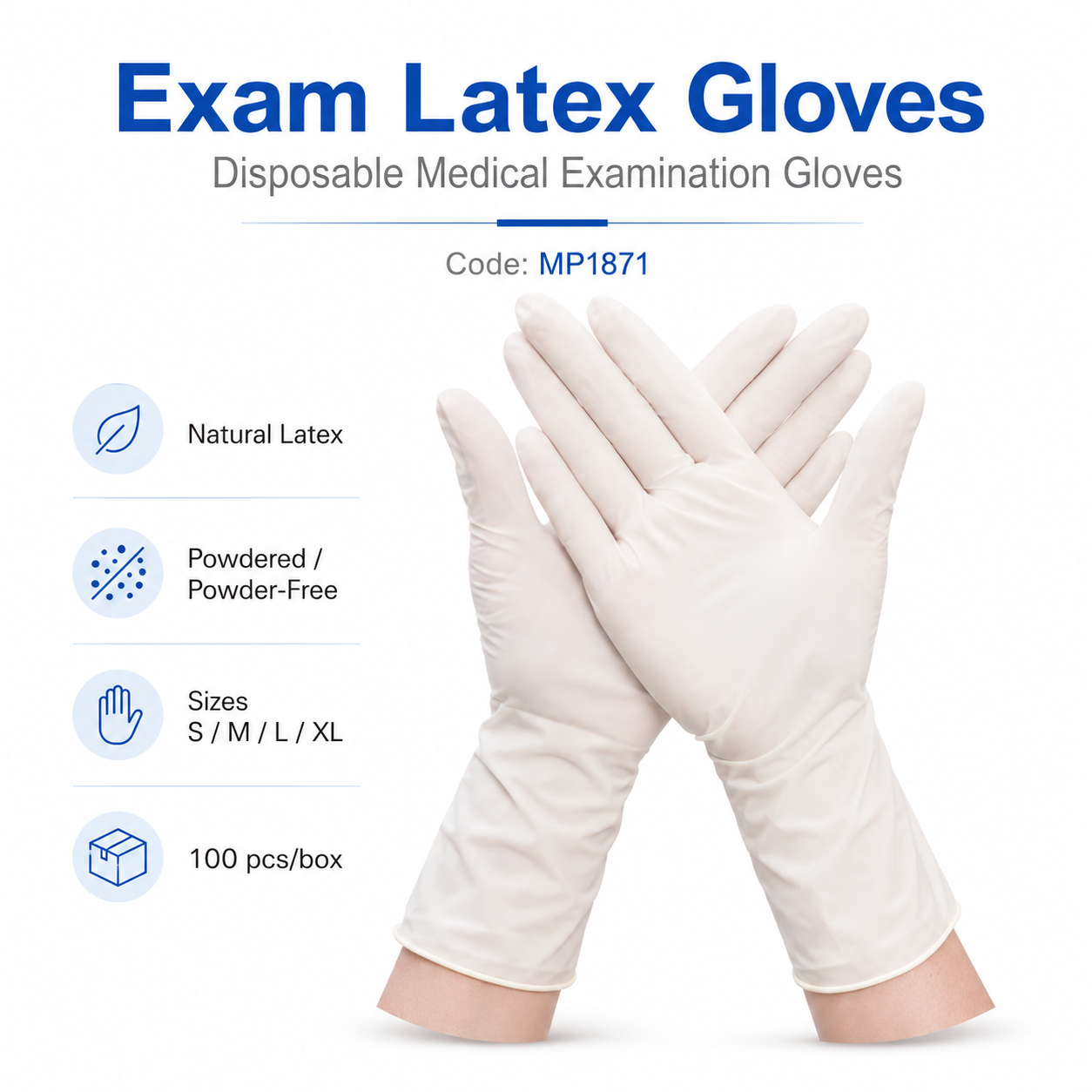
Latex, made from natural rubber, has long been the benchmark for tactile sensitivity, elasticity, and fit. It offers excellent barrier protection and a comfortable "second-skin" feel that surgeons in particular value. Its defining drawback is the risk of Type I (immediate hypersensitivity) latex allergy, caused by natural rubber latex proteins, which can affect both wearers and patients. This allergy risk is the single biggest reason many facilities have shifted away from latex for general examination use, even though the material's mechanical performance remains outstanding. The Exam Latex Gloves_MP1871 and the Sterile Surgical Latex Gloves_MP1871S serve the settings where latex's fit and sensitivity are most prized.
Nitrile, a synthetic acrylonitrile-butadiene rubber, has become the dominant general-purpose examination glove. It carries no natural rubber latex proteins, so it eliminates Type I latex allergy risk, and it offers superior puncture and chemical resistance compared with both latex and vinyl. Nitrile's resistance to many oils, solvents, and chemicals makes it the default in laboratories and in any setting handling cytotoxic or hazardous substances. Modern nitrile formulations have closed much of the historic comfort gap with latex. The Exam Nitrile Gloves_MP1873 sits at the center of this category.
Vinyl (PVC) is the economy option. It is latex-free and inexpensive, making it well suited to short-duration, low-risk tasks — food handling, light cleaning, non-hazardous examinations, and high-turnover settings where gloves are changed frequently. Its trade-offs are real: lower elasticity, a looser fit, and reduced barrier integrity under stress, with a tendency for micro-perforations to develop during use. Vinyl is therefore generally not recommended for high-risk procedures or prolonged contact with blood and body fluids. The Vinyl Gloves_MP1870 is positioned for exactly the cost-sensitive, low-risk applications where it excels.

| Criterion | Nitrile (MP1873) | Latex (MP1871) | Vinyl (MP1870) |
|---|---|---|---|
| Barrier protection | Excellent | Excellent | Moderate; degrades under stress |
| Puncture resistance | High | Moderate–high | Low |
| Chemical resistance | High (oils, many solvents) | Moderate | Low |
| Tactile sensitivity / fit | Very good | Excellent | Fair |
| Latex (Type I) allergy risk | None | Yes | None |
| Relative cost | Mid | Mid | Lowest |
| Best fit | General exam, lab, hazardous handling | Surgery, high-dexterity tasks | Short, low-risk, food & light duty |
Powder-Free as the Modern Standard
Historically, gloves were dusted with cornstarch powder to ease donning. That practice has largely been abandoned in healthcare. Powder can carry latex proteins into the air and into wounds, contributing to allergic sensitization and post-surgical complications such as adhesions and granulomas. Regulators have moved decisively against powdered surgical and examination gloves; in the US, the FDA banned most powdered medical gloves. The result is that powder-free is now the expected default for medical-grade gloves across nitrile, latex, and vinyl. Powder-free gloves are produced using chlorination or polymer coatings on the inner surface to ease donning without loose powder. When sourcing, confirm powder-free status explicitly — it should not be assumed — and for any latex line, ask about the protein content, which a quality manufacturer will keep low.
AQL, Thickness, and the Standards Framework
The most important single number in glove procurement is the AQL — Acceptable Quality Level — for pinholes. AQL is a statistical sampling standard that defines the maximum acceptable proportion of defective units in a lot. For examination and surgical gloves, the AQL refers chiefly to watertightness: the proportion of gloves that may leak when tested. An AQL of 1.5 means that, under the sampling plan, a lot is accepted if no more than roughly 1.5% of units are defective for pinholes. Lower AQL is better; medical examination gloves are commonly specified at AQL 1.5, while surgical gloves are typically held to a tighter AQL, such as 1.0 or lower.
AQL 1.5 is the floor for a credible medical examination glove, not a marketing flourish. Always confirm the AQL is for watertightness, the test method behind it, and the inspection level the supplier applies.
Glove thickness, usually expressed in mils (thousandths of an inch) and measured at finger, palm, and cuff, influences both barrier robustness and tactile feel. Thicker gloves resist puncture better but reduce sensitivity; the right thickness depends on the task. The relevant standards bundle these properties together:
- EN 455 (parts 1–4) is the European standard for single-use medical gloves, covering freedom from holes (AQL), physical properties, biological evaluation, and shelf-life determination.
- ASTM D6319 is the US specification for nitrile examination gloves.
- ASTM D3578 is the specification for rubber (latex) examination gloves.
- ASTM D5250 is the specification for poly(vinyl chloride) (vinyl) examination gloves.
For any glove sold as a medical device, request the test reports against the standard matching the material and destination market, and confirm the manufacturer's ISO 13485 quality system and CE marking (and FDA 510(k) clearance for the US examination glove market). Tensile strength and elongation before and after accelerated aging are part of these standards and are a useful proxy for whether a glove will perform at the end of its stated shelf life, not just when fresh.
Examination vs Sterile Surgical Gloves
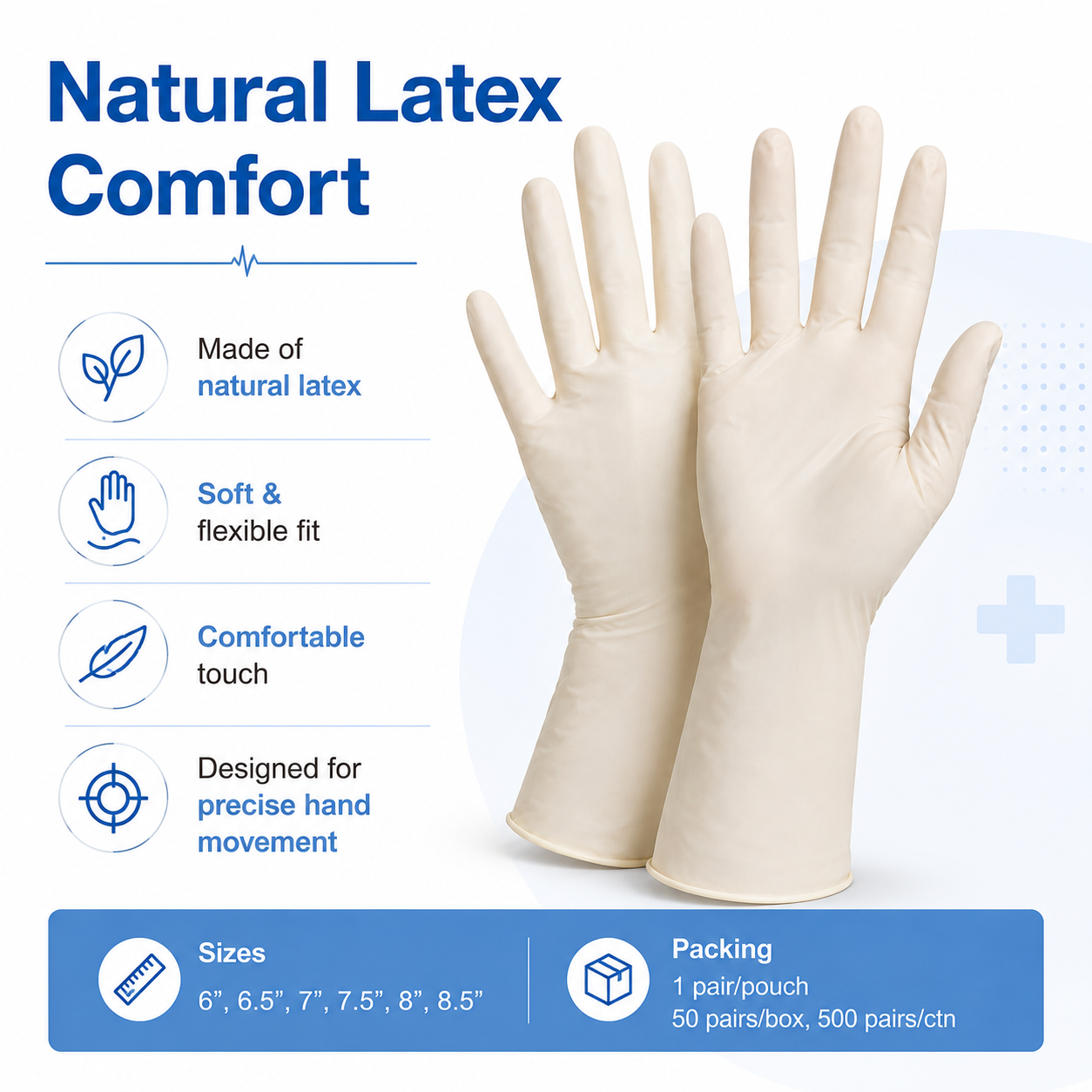
Examination gloves and surgical gloves are different product classes, not merely different grades. Examination gloves (MP1870, MP1871, MP1873) are typically ambidextrous, sized in broad bands (S/M/L/XL), supplied non-sterile in bulk dispenser boxes, and held to an AQL around 1.5. They are designed for general patient contact and non-invasive procedures, where high volume and quick changes are the priority.
Sterile surgical gloves such as the Sterile Surgical Latex Gloves_MP1871S are a more exacting product. They are hand-specific (anatomically shaped left and right), sized in precise half-size increments (e.g. 6.0, 6.5, 7.0) for an exact fit that preserves dexterity through long procedures, supplied sterile in individually sealed peel-pack pouches for aseptic donning at the sterile field, and held to a tighter AQL. Their packaging must comply with ISO 11607, the standard for terminally sterilized device packaging, covering sterile barrier integrity and validated shelf life. Sterilization is commonly by gamma irradiation. When a procedure breaches the body's natural barriers, sterile surgical gloves are required — examination gloves, however high quality, are not a substitute.
Sizing, Grades, and Application Boundaries
Correct sizing is a clinical and economic issue: gloves that are too tight cause fatigue and tearing, while loose gloves compromise dexterity and barrier integrity. Examination gloves use band sizing; surgical gloves use numeric half-sizes. Provide end users with a clear sizing chart and, for tenders, confirm the size mix to avoid over-ordering rarely used extremes.
Be alert to grade boundaries. Not every glove that looks like a medical glove is one. Food-grade gloves must meet food-contact safety regulations but are not medical devices and should not be substituted into clinical use. Industrial-grade gloves may be thicker and more chemically resistant but are not validated for patient contact and carry no medical AQL guarantee. A reputable manufacturer clearly designates the intended grade of each line; insist that the grade matches the application and that the documentation supports it. Cross-grading — buying cheaper industrial or food gloves for clinical use — is a false economy that creates liability.
Procurement and Quality Control
Gloves are commodity-volume products with thin margins, which makes disciplined supplier qualification and inspection essential to protect both quality and price. Before committing, request and verify:
- Quality system & clearances: ISO 13485 certification, CE marking with EN 455 reports, and FDA 510(k) clearance with the matching ASTM report (D6319 nitrile, D3578 latex, D5250 vinyl) for the US market.
- Item-specific test data: AQL for watertightness (confirm 1.5 for exam, tighter for surgical), thickness at finger/palm/cuff, tensile/elongation before and after aging, and powder-free confirmation; for latex, protein-content data.
- Sterile documentation (for MP1871S): sterilization method and validation, ISO 11607 packaging validation, and shelf life.
- Commercial terms: MOQ, lead time, OEM/private-label scope, and Incoterms.
Glove MOQs are typically large — expressed in cartons of many thousands of pieces — reflecting high-throughput dipping-line production; custom colors, cuff lengths, or OEM-printed boxes raise the MOQ. Lead times for stock lines are generally measured in weeks and extend for sterile or private-label runs. JPS Medical supports OEM and private-label programs across the MP1870 to MP1873 range and the sterile MP1871S, including custom box printing, glove color, and texture. Settle Incoterms early — FOB and CIF are standard for the container-scale sea freight that gloves usually move under. Critically, agree a written pre-shipment inspection protocol: a glove AQL inspection should include the watertightness (pinhole) test on a statistically valid sample, dimensional and thickness checks, tensile testing, visual defect grading against the agreed AQL, and confirmation of powder-free status. For sterile gloves, add packaging-integrity and seal checks. This turns the AQL from a number on a spec sheet into a verified property of the goods you actually receive.
Key Takeaways
- Nitrile (MP1873) is the latex-free, puncture- and chemical-resistant general-purpose default; latex (MP1871/MP1871S) offers the best fit but carries Type I allergy risk; vinyl (MP1870) is the economy choice for short, low-risk tasks.
- Powder-free is the modern medical standard — confirm it explicitly and ask about latex protein content.
- AQL 1.5 (watertightness) is the floor for medical exam gloves; surgical gloves require a tighter AQL. Verify the test method and inspection level.
- Match the standard to the material and market: EN 455, ASTM D6319 (nitrile), D3578 (latex), D5250 (vinyl).
- Examination and sterile surgical gloves are different classes; sterile gloves (MP1871S) require hand-specific half-sizing and ISO 11607 packaging, and cannot be substituted by exam gloves for invasive procedures.
- Never cross-grade food or industrial gloves into clinical use; qualify suppliers on ISO 13485, CE/FDA clearances, item-specific test data, MOQ, lead time, OEM scope, Incoterms, and a written AQL inspection plan.
Need a quote on Surgical & Examination Gloves?
Tell us your target quantity and destination — our B2B team replies within one business day with factory-direct pricing, lead time and OEM options.