
Medical Bandages and Tapes: Cohesive, Crepe, Kinesiology and More
Bandages and tapes occupy a deceptively complex corner of the medical-disposables market. To the casual eye they are interchangeable strips of fabric, but in practice each type — cohesive, crepe, high-elastic, tubular net, orthopedic cast padding and kinesiology tape — is engineered for a specific clinical or sporting job, with its own stretch profile, material blend, width range and packaging convention. For distributors, importers and procurement teams, this category is attractive precisely because it spans clinical supply, sports medicine, veterinary and consumer retail, and because much of it lends itself to private-label printing and colour customisation. The flip side is that getting the stretch percentage, fibre content and sizing wrong leads to product that simply does not perform. This guide explains the main bandage and tape families, how they differ, and the sourcing and quality-control decisions that keep a programme profitable and complaint-free.
Cohesive Bandages: Self-adherent and Latex Considerations
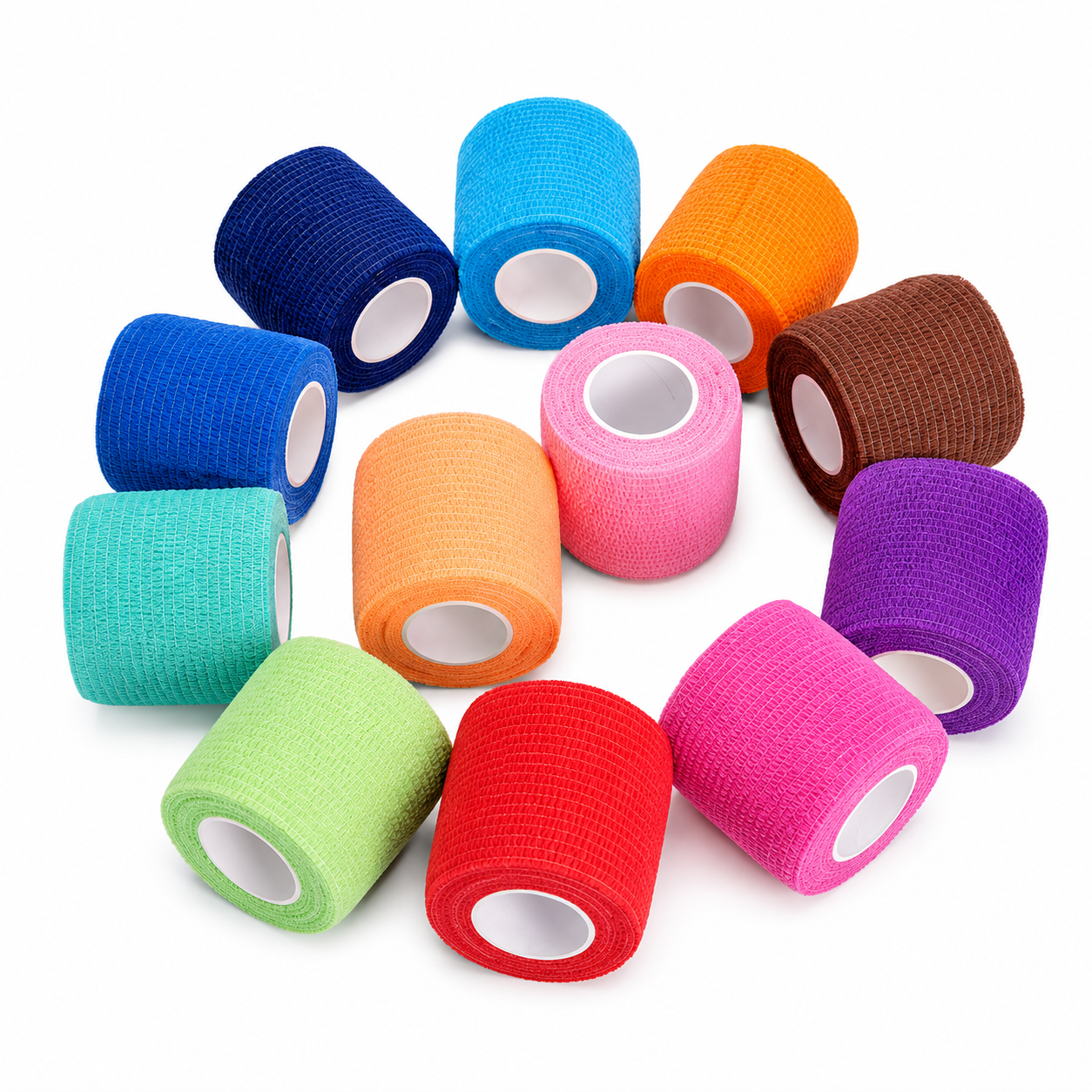
A cohesive bandage sticks to itself but not to skin, hair or clothing — the defining trick of the category. This self-adherence comes from a coating or treatment applied to a stretchable nonwoven or knitted web, so the bandage grips its own overlapping layers and stays put without pins, clips or adhesive tape. The result is a secure, comfortable wrap that flexes with movement and is easy to remove without pulling skin or hair. The Cohesive Bandage (MB25040) is the everyday clinical and first-aid workhorse, used to secure dressings, provide light support and hold IV cannulae or sensors in place.
Two product extensions broaden the appeal. The Neon Cohesive Bandage (MB25046) uses bright, high-visibility colours favoured in sports settings, paediatrics and veterinary practice, where colour aids identification and engagement. The Printed Cohesive Bandage (MB2049) carries patterns, logos or branding — a natural fit for private-label programmes and promotional or retail packs. Across all cohesive bandages, the single most important sourcing question is latex content. Traditional cohesive bandages used natural rubber latex for their cling and stretch; because latex allergy is a recognised clinical risk, many tenders and end users now require latex-free cohesive bandages. A capable manufacturer offers both, and procurement should specify which is required for each destination and clinical setting.
The two questions that decide whether a cohesive bandage fits a tender are simple: is it latex-free, and does it keep its cling after time in a warm warehouse? Specify both — latex status and shelf-stable adhesion — not just colour and width.
Crepe, High-Elastic and Tubular Net Bandages
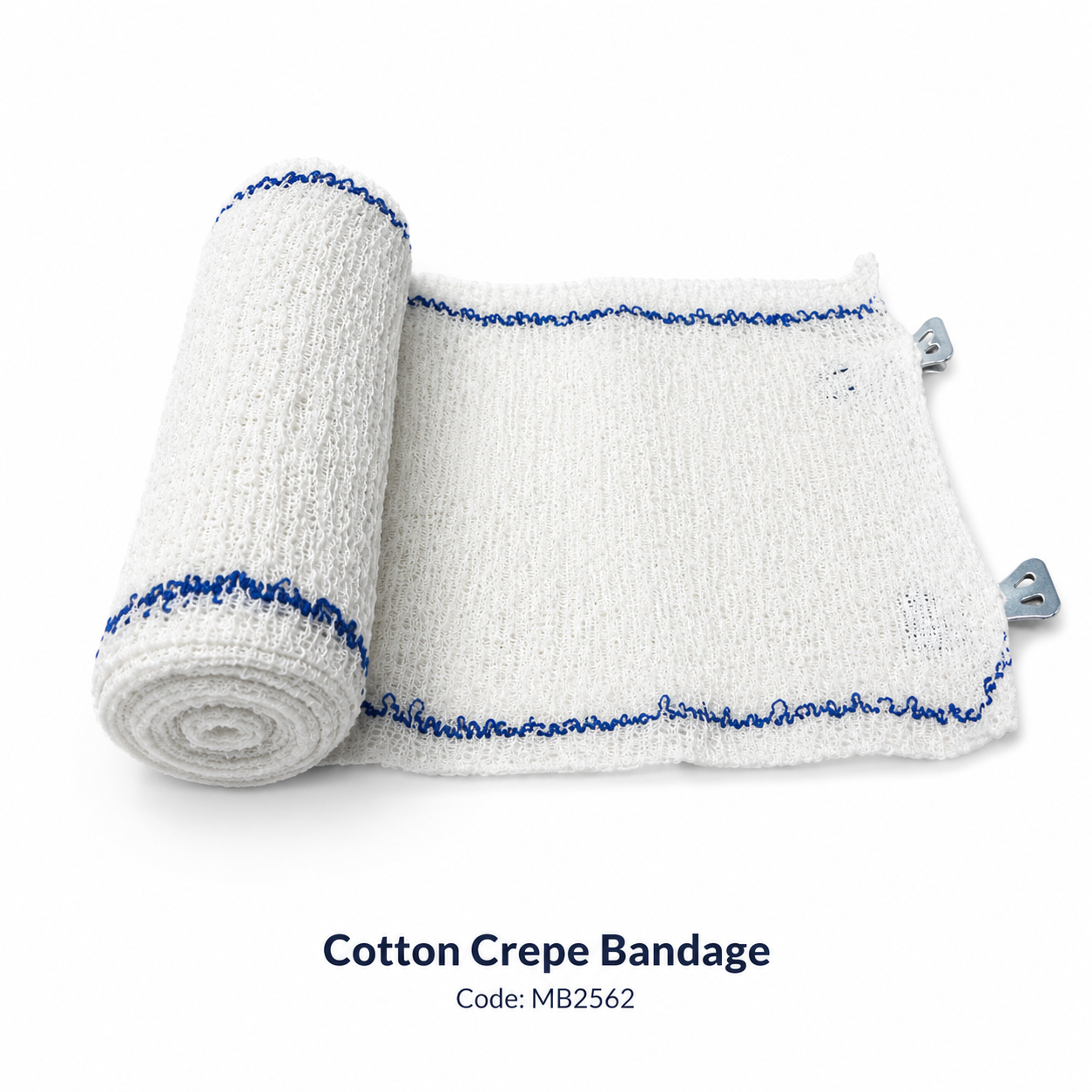
Where cohesive bandages cling to themselves, crepe and elastic bandages rely on weave and fibre to provide stretch and support, and are secured with clips or tape. The Cotton Crepe Bandage (MB2562) is a woven cotton (often cotton with a small spandex or crepe-twist content) bandage that provides light, even compression and support for sprains, strains and dressing retention. Its hallmark is a gentle, recoverable stretch and a soft, skin-friendly handle. Crepe bandages are graded by width and by stretched/unstretched length, and quality depends on consistent weave, even edges and reliable elastic recovery wash after wash where reusable grades are offered.
The Skin Color High Elastic Bandage (MB2561) offers a higher stretch percentage for firmer compression and support, in a discreet skin tone that blends with the patient. It is used where stronger, conforming compression is needed over joints and limbs. The Tubular Net Bandage (MB2567) is a different concept entirely: a seamless elasticated net tube that slips over a limb, digit, head or torso to hold dressings in place without wrapping. Supplied in numbered sizes for different body parts, it is fast to apply, breathable and economical, and is a staple of burns units and busy wards. Sizing is the critical specification here — the net must stretch to grip the body region snugly without constricting.
Orthopedic Cast Padding and Under-cast Protection
The Orthopedic Bandage Cast Padding (MB2563) serves a specialised role beneath plaster of Paris or synthetic casts. It is a soft, loftable polyester or cotton-blend padding wound directly onto the limb before the rigid casting material is applied, protecting the skin, distributing pressure and preventing the hard cast from chafing bony prominences. Good cast padding has high loft and resilience so it cushions without compressing flat, conforms smoothly around contours, and tears cleanly by hand for quick application. It works as part of a system with stockinette and casting tape, so distributors serving orthopaedic and fracture clinics benefit from offering the complementary components together.
Because cast padding is applied to potentially compromised skin and stays in place for weeks, breathability, low linting and freedom from irritants matter. Procurement should confirm fibre content, width range and roll length, and whether the padding is intended for use under plaster, synthetic or both.
Kinesiology Tape: Material and Performance
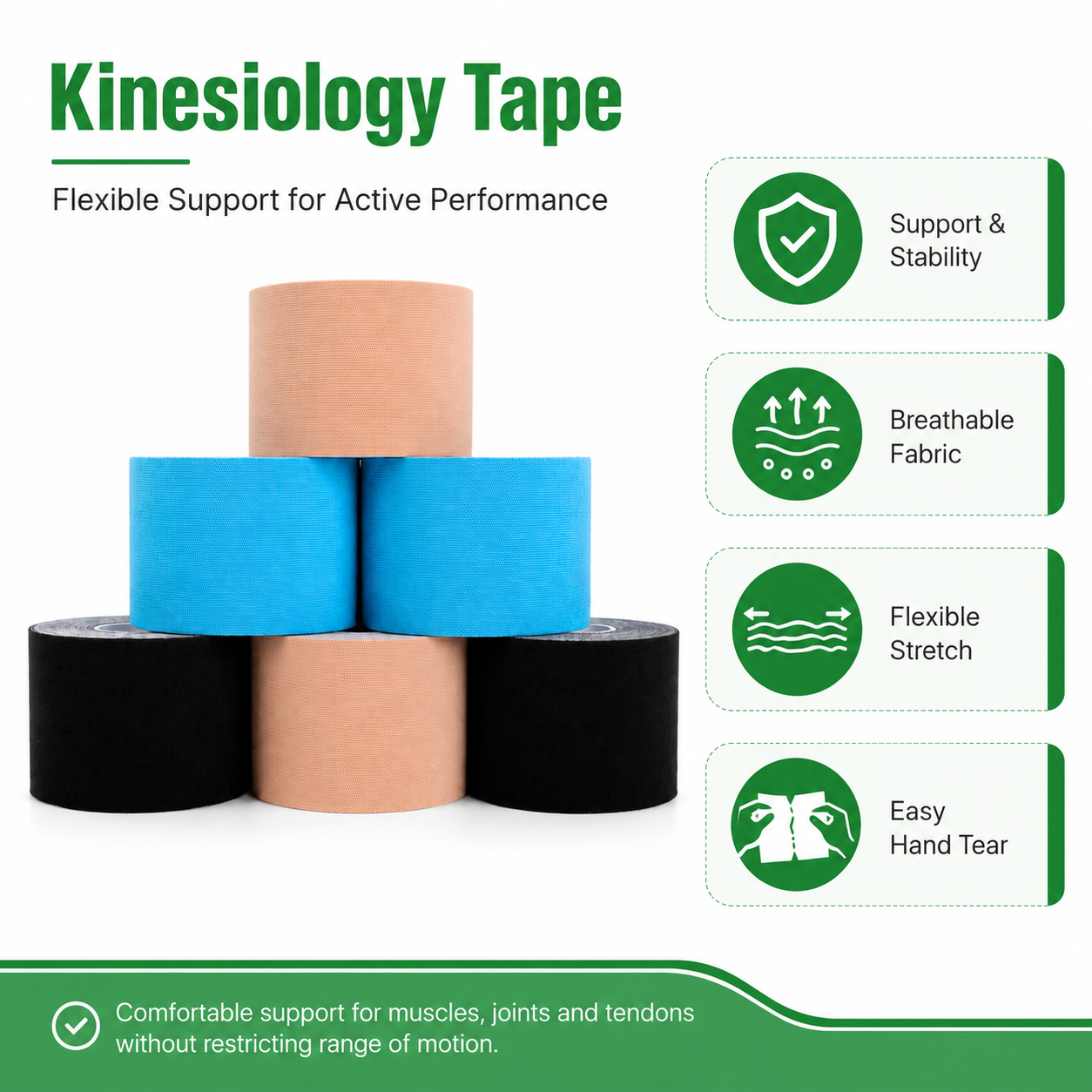
The Kinesiology Tape (MB2660) sits at the sports-and-wellness end of the category and has become a major retail and clinical line. It is an elastic cotton or synthetic tape with a wave-pattern acrylic adhesive, designed to stretch with the skin and stay adhered through movement, sweat and water for several days. The construction is specific: a cotton or cotton/nylon facing for breathability and feel, elastane (spandex) for the stretch, and a heat-activated acrylic adhesive laid down in a pattern that lets skin breathe and lifts the tape's grip. Performance markers are stretch percentage (commonly in the region of higher elongation than rigid tapes), water resistance, wear time and skin-friendliness of the adhesive.
Kinesiology tape is heavily driven by colour and branding, which makes it one of the strongest private-label opportunities in the whole bandage category. It is sold in single rolls, multi-packs, pre-cut strips and bulk clinic rolls, in a wide palette and with printed designs. For a distributor, the commercial value lies as much in attractive, market-appropriate packaging and colour range as in the tape itself.
| Product | Self-adherent / secured | Typical stretch | Material | Primary use |
|---|---|---|---|---|
| Cohesive Bandage (MB25040) | Self-adherent | Light–moderate | Nonwoven, latex or latex-free | Dressing retention, light support |
| Neon / Printed Cohesive (MB25046 / MB2049) | Self-adherent | Light–moderate | Nonwoven, coloured/printed | Sports, paediatric, retail, branding |
| Cotton Crepe Bandage (MB2562) | Secured (clip/tape) | Moderate, recoverable | Woven cotton / crepe twist | Light compression, support |
| Skin Color High Elastic (MB2561) | Secured | High | Cotton + elastane | Firm conforming compression |
| Tubular Net Bandage (MB2567) | Pull-on net | High (net) | Elasticated net | Dressing retention, no wrap |
| Cast Padding (MB2563) | Wound on, under cast | Low (loft) | Polyester / cotton blend | Under-cast skin protection |
| Kinesiology Tape (MB2660) | Adhesive | High elastic | Cotton/nylon + spandex, acrylic glue | Sports support, retail |
Retail vs Clinical, Private Label and Sizing
One of the strengths of the bandage and tape category is that the same core products serve both clinical procurement and consumer retail, but the packaging, presentation and regulatory requirements differ. Clinical buyers want bulk, plain or institutionally branded packs, defined sizes and supporting documentation. Retail buyers want eye-catching colours, printed designs, blister or box packaging with multilingual instructions and barcodes, and consistent shelf presentation. The Neon Cohesive (MB25046), Printed Cohesive (MB2049) and Kinesiology Tape (MB2660) are especially suited to private-label and colour customisation, where a distributor can build a differentiated brand around standard manufacturing.
Sizing and packaging precision underpin everything. Bandage width (2.5 cm, 5 cm, 7.5 cm, 10 cm, 15 cm), stretched and unstretched length, roll count per box and box count per carton must all be agreed and held to a tolerance. For tubular net, the numbered size system must be clearly mapped to body regions. For kinesiology tape, roll length and width plus pre-cut format need definition. Agreeing these specifications in writing, with a tolerance, prevents the recurring "the rolls are shorter than last time" disputes that quietly erode trust and margin.
Procurement, Certification and QC
For distributors and importers, the commercial and quality framework around bandages and tapes should be settled before the first order. A credible China-based manufacturer such as JPS Medical should provide:
- Certification: ISO 13485 (and EN ISO 13485) quality management certification, CE marking under the EU MDR where products are placed on the EU market, and FDA registration where sold in the US. For cohesive bandages, request explicit confirmation of latex or latex-free status.
- Material and performance data: fibre content, stretch percentage, adhesive type and skin-contact safety, plus any biocompatibility evidence relevant to skin-contact devices.
- MOQ and lead time: confirm minimums, especially for custom colours and printed/private-label runs, and realistic production plus freight lead times.
- OEM / private label: custom colours, printed designs, branded boxes and multilingual retail packaging appropriate to the destination market.
- Incoterms: agree FOB, CIF or DDP so freight, insurance and customs responsibilities are unambiguous.
- QC and AQL: an inspection plan with Acceptable Quality Limits covering critical defects (loss of adhesion, latex mislabelling, wrong dimensions), major and minor defects, with the right to pre-shipment inspection.
The recurring quality risks in this category are loss of cohesion or adhesion over time and in heat, inconsistent stretch and recovery, and dimensional drift between production batches. Specifying stretch percentage, latex status, adhesive performance and sizing with tolerances — and backing it with an AQL inspection — turns a varied, fashion-sensitive product range into a dependable, repeatable supply programme that serves clinical tenders and retail shelves alike.
Key Takeaways
- Cohesive bandages (MB25040, and coloured MB25046 / printed MB2049) self-adhere without sticking to skin — always specify latex or latex-free.
- Crepe (MB2562) and high-elastic skin-tone (MB2561) bandages provide graded compression and are secured with clips; tubular net (MB2567) retains dressings without wrapping and is sized by body region.
- Cast padding (MB2563) protects skin under casts and must offer high loft, clean tear and breathability.
- Kinesiology tape (MB2660) combines cotton/spandex with wave-pattern acrylic adhesive for high-stretch, water-resistant wear — a leading private-label and retail opportunity.
- Lock down certification (ISO 13485, CE, FDA), latex status, stretch and adhesive data, sizing tolerances, MOQ, OEM, Incoterms and an AQL-based QC plan before ordering.
Need a quote on Bandages and Tapes?
Tell us your target quantity and destination — our B2B team replies within one business day with factory-direct pricing, lead time and OEM options.