
Medical Face Masks Decoded: BFE, PFE, ASTM Levels and Respirators
Few medical disposables carry as much specification confusion as the humble face mask. A product that looks identical across a dozen suppliers can vary enormously in filtration efficiency, breathability, and fluid resistance — and those differences are exactly what separate a compliant medical device from a piece of fabric that offers a false sense of protection. For distributors, importers, and hospital procurement teams, the ability to read a mask specification correctly — BFE, PFE, differential pressure, fluid resistance, and the ASTM and EN classifications that bundle them together — is the difference between sourcing a defensible product and inheriting a regulatory liability.
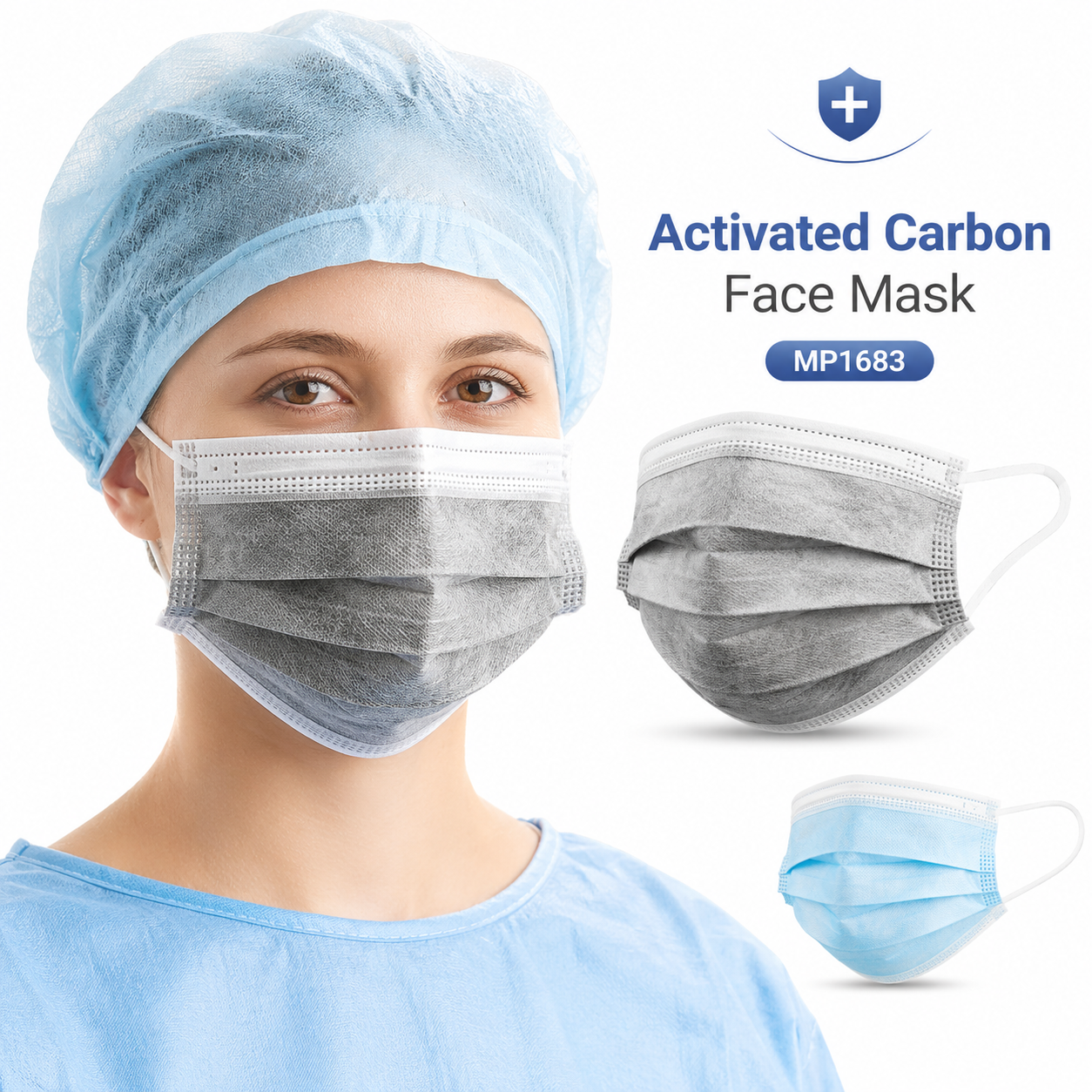
This guide decodes the terminology, explains the construction that drives performance, clarifies where surgical masks end & respirators begin, and lays out a procurement framework. We reference the JPS Medical mask range — the Face Mask_MP1600, Dust Mask_MP1610, Particulate Respirator_MP1616, Face Mask With Shield_MP1620, and Activated Carbon Face Mask_MP1683 — to ground the standards in concrete sourcing choices.
Three-Ply Construction and the Meltblown Core
A standard medical face mask is a three-ply (3-ply) device, and understanding the role of each layer is the starting point for every quality conversation. The outer layer is a spunbond nonwoven that is fluid-repellent and faces the environment; it is the colored side. The middle layer is meltblown nonwoven — the filtration heart of the mask. The inner layer is a soft spunbond that contacts the face and is selected for comfort and moisture absorption.
The meltblown middle layer does the real work. Its fibers are extraordinarily fine and randomly oriented, and they are typically given an electrostatic charge during manufacture. Particles are captured both mechanically (by the physical mesh) and electrostatically (by attraction to the charged fibers), which is how a thin layer can achieve high filtration efficiency without becoming impossible to breathe through. The quality and basis weight of the meltblown layer, and whether its charge is stable over time, are the single biggest determinants of a mask's real-world performance. When a "medical mask" underperforms, it is almost always because the meltblown layer was thin, uncharged, or substituted with ordinary spunbond. This is precisely the kind of substitution that pre-shipment testing exists to catch.
BFE vs PFE: Two Different Filtration Metrics
The two filtration numbers buyers will see most often are BFE and PFE, and confusing them is a common and costly error.
BFE (Bacterial Filtration Efficiency) measures the percentage of bacteria-laden aerosol droplets a mask captures, using a test aerosol of Staphylococcus aureus with a mean particle size around 3.0 microns. BFE is the baseline efficiency metric for surgical and medical masks. ASTM-compliant medical masks require a BFE of at least 95% (Level 1) or 98% (Levels 2 and 3).
PFE (Particle Filtration Efficiency) measures filtration of much smaller, non-viable particles — commonly at 0.1 micron in the most demanding protocols. Because smaller particles are harder to capture, a high PFE at a small particle size is a more stringent indicator of filtration quality than BFE alone. A mask can have an excellent BFE but a modest PFE if its filtration is effective only against larger droplets.
When comparing quotes, always ask at what particle size the PFE was measured. "PFE 99%" at 3.0 microns is not comparable to "PFE 99%" at 0.1 micron. Request the test report, not just the headline figure, and confirm the testing laboratory and method.
Breathability (ΔP) and Fluid Resistance
Filtration is only half the equation. A mask that filters perfectly but cannot be breathed through is unusable, so medical mask standards also specify breathability and, for higher tiers, fluid resistance.
Differential pressure (ΔP, "delta P") measures the pressure drop across the mask material — effectively, how hard the wearer must work to breathe. It is expressed in mm H₂O per cm². Lower ΔP means easier breathing. The engineering tension is fundamental: increasing filtration usually increases ΔP, so a well-designed mask balances the two. ASTM sets maximum ΔP limits at each level to ensure masks remain breathable even as filtration rises.
Fluid resistance measures the mask's ability to resist penetration by a synthetic blood splash at a specified pressure (120, 140, or 160 mm Hg, corresponding to ASTM Levels 1, 2, and 3). This matters in procedures where blood or body fluids may spray toward the face. A higher fluid-resistance rating is what differentiates a procedure mask used for splash-prone surgery from a basic mask used for routine examination.
ASTM F2100 Levels and EN 14683 Types
These individual metrics are bundled into the two classification systems buyers must know: ASTM F2100 (US) and EN 14683 (Europe).
ASTM F2100 defines three performance levels by combining BFE, PFE, ΔP, fluid resistance, and flammability into a single rating. EN 14683 classifies masks as Type I, Type II, or Type IIR, where the "R" indicates splash resistance. The two systems are related but not identical — for example, EN 14683 specifies BFE thresholds and ΔP but defines its bacterial filtration and breathability requirements somewhat differently from ASTM, so a mask should be tested against whichever standard governs the destination market.
| Standard / Class | BFE | Fluid Resistance | Breathability (ΔP) | Typical Use |
|---|---|---|---|---|
| ASTM Level 1 | ≥95% | 80 mm Hg | <5.0 mm H₂O/cm² | Low fluid, routine exam, short procedures |
| ASTM Level 2 | ≥98% | 120 mm Hg | <6.0 mm H₂O/cm² | Moderate fluid/aerosol exposure |
| ASTM Level 3 | ≥98% | 160 mm Hg | <6.0 mm H₂O/cm² | Heavy fluid/spray procedures |
| EN 14683 Type I | ≥95% | Not required | <40 Pa/cm² | Patients & low-risk, non-surgical use |
| EN 14683 Type II | ≥98% | Not required | <40 Pa/cm² | Surgical, low splash risk |
| EN 14683 Type IIR | ≥98% | ≥120 mm Hg | <60 Pa/cm² | Surgical with splash risk |
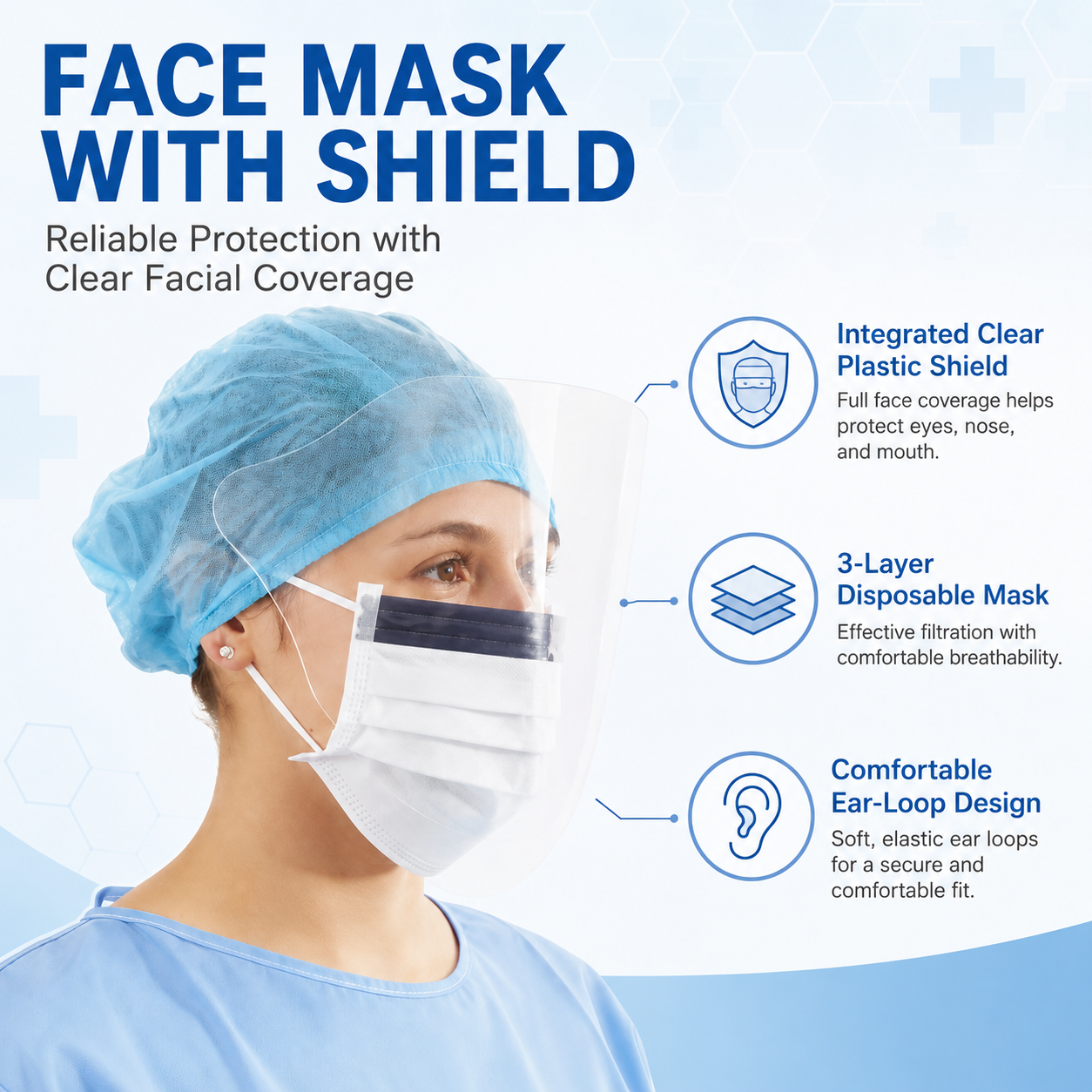
The MP1600 Face Mask and MP1620 Face Mask With Shield map naturally onto these tiers; the integrated visor on the MP1620 adds eye and full-face splash protection on top of the mask's own fluid-resistance rating, which is valuable in spray-prone procedures where ASTM Level 3 or EN Type IIR performance is indicated.
Respirators vs Surgical Masks: A Critical Distinction
One of the most consequential misunderstandings in this category is treating surgical masks and respirators as interchangeable. They protect against different things.
A surgical (medical) mask is a fluid barrier and source-control device. It protects the sterile field and the patient from the wearer's expelled droplets and protects the wearer's face from splashes. It is loose-fitting and does not form a seal, so it does not reliably protect the wearer from inhaling fine airborne particles.
A respirator — N95 (US, NIOSH), FFP2/FFP3 (Europe, EN 149), or KN95 (China, GB2626) — is designed to seal to the face and filter the air the wearer inhales, protecting against fine aerosols and airborne particles. An N95 filters at least 95% of 0.3-micron particles; FFP2 and KN95 have broadly comparable but separately defined requirements. Crucially, fit matters: a respirator only delivers its rated protection when it seals properly, which is why fit-testing programs exist in clinical settings.
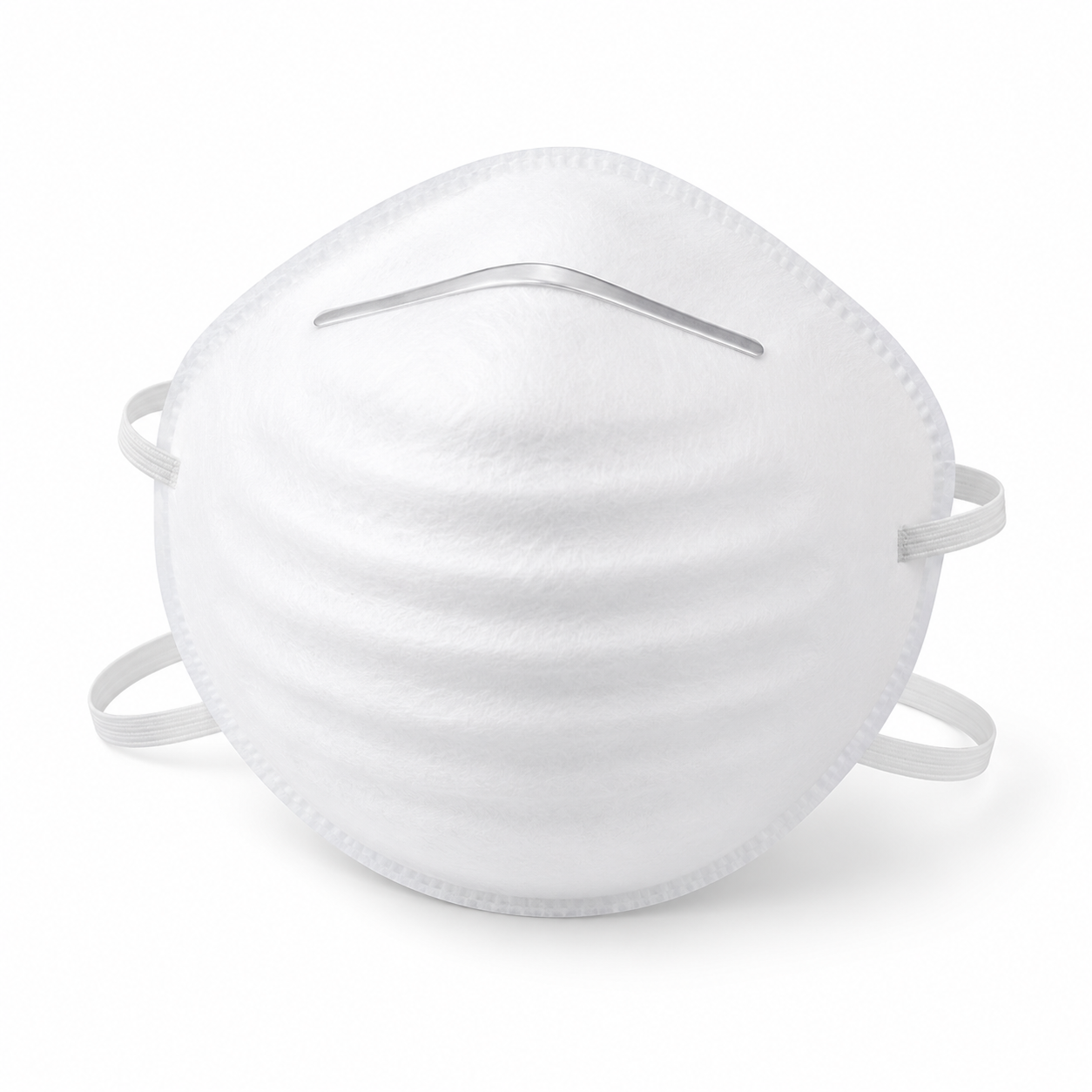
The JPS Particulate Respirator_MP1616 belongs to this respirator category, engineered for a facial seal and particulate filtration rather than mere splash resistance. The Dust Mask_MP1610, by contrast, is positioned for particulate and nuisance-dust filtration in lighter-duty contexts. When a customer asks for "N95-equivalent" product, confirm precisely which standard (NIOSH N95, EN 149 FFP2, or GB2626 KN95) is required by their jurisdiction, because the certifications and test reports are not interchangeable even when the filtration percentages look similar.
A surgical mask protects the patient from you; a respirator protects you from the air. Buying one when the clinical risk demands the other is the most expensive mistake in mask procurement.
Ear-Loop vs Tie-On, Activated Carbon, and Selecting by Risk
Beyond filtration class, two design choices recur in tenders. Ear-loop masks are faster to don and doff and dominate high-turnover settings such as examinations and general ward use. Tie-on masks allow a more adjustable, customized fit and are often preferred in the operating room for longer wear, where the tie tension can be set to the individual and stays put through a long case. Both can meet the same ASTM level; the choice is ergonomic, not a filtration matter.
Activated carbon masks, such as the JPS Activated Carbon Face Mask_MP1683, add a carbon layer that adsorbs odors and certain organic vapors. It is important to set expectations accurately: the carbon layer is for odor and nuisance-vapor reduction (useful in dental, laboratory, laser-plume, and certain environmental settings), not a substitute for the gas-cartridge respirators required for genuine chemical hazards. Position activated carbon masks for comfort and odor control, never as chemical protection.
Selecting by clinical risk is the disciplined approach: low-risk, low-fluid exam work calls for an ASTM Level 1 / EN Type I or II mask; procedures with moderate or heavy splash risk call for Level 2–3 / Type IIR, optionally with a shield as on the MP1620; airborne-pathogen and fine-aerosol exposure calls for a fit-tested respirator such as the MP1616. Buying up the chain "to be safe" wastes budget and increases ΔP unnecessarily; buying down the chain creates risk. Match the device to the documented exposure.
Procurement, Certifications, and Quality Control
Mask sourcing has been a notorious area for substandard and counterfeit product, so supplier qualification must be rigorous. Request and verify the following before ordering:
- Quality system: Current ISO 13485 certification for medical mask manufacturing.
- Market clearances: CE marking with the relevant EN 14683 (medical masks) or EN 149 (respirators) test reports for the EU; FDA 510(k) clearance and ASTM F2100 reports for the US medical mask market; NIOSH approval for N95 respirators.
- Item-specific test reports: BFE, PFE (with stated particle size), ΔP, fluid resistance, and flammability for the exact SKU — from a recognized laboratory, dated, and traceable to the lot.
- Meltblown verification: Confirmation of meltblown content and basis weight, since this is the most commonly substituted component.
On commercial terms, masks are typically high-volume, lower-unit-cost items, so MOQs are usually expressed in cartons of thousands of pieces; expect higher MOQs for custom-printed or OEM/private-label configurations. Lead times for in-line stock items are generally short, extending for custom colors, branded packaging, or respirator lines that require additional certification handling. JPS Medical offers OEM and private-label programs across the MP1600 through MP1683 range, including custom earloop colors, printed nose-wire panels, and branded retail or bulk packaging. Agree Incoterms (commonly FOB or CIF for the large sea-freight volumes typical of masks) and a written inspection plan up front. Mask AQL inspections should cover dimensional checks, earloop/tie weld strength, nose-wire retention, ply count, and a sample pull for laboratory re-testing of BFE/ΔP, so that filtration claims are verified rather than assumed.
Key Takeaways
- Medical masks are 3-ply devices whose performance hinges on the charged meltblown middle layer — the most commonly substituted component.
- BFE and PFE measure different things; always confirm the particle size at which PFE was tested.
- ΔP (breathability) and fluid resistance complete the picture; ASTM F2100 (Levels 1–3) and EN 14683 (Type I/II/IIR) bundle these metrics for the US and EU respectively.
- Surgical masks and respirators (N95/FFP2/KN95) protect against different hazards and are not interchangeable; respirators require a facial seal and fit-testing.
- Ear-loop vs tie-on is an ergonomic choice; activated carbon (MP1683) controls odor, not chemical hazards.
- Qualify suppliers on ISO 13485, CE/FDA clearances, item-specific dated test reports, meltblown verification, MOQ, lead time, OEM scope, Incoterms, and an AQL plan including lab re-testing.
Need a quote on Face Masks?
Tell us your target quantity and destination — our B2B team replies within one business day with factory-direct pricing, lead time and OEM options.