
Sterilization Pouches and Wrapping: A Complete CSSD Sourcing Guide
Inside every hospital, the Central Sterile Services Department (CSSD) quietly determines whether the operating room can function safely. The pouches, rolls, paper bags and wrapping sheets that pass through it are not commodities; they are sterile barrier systems engineered to a body of international standards. For distributors, importers and hospital procurement teams, sourcing these consumables well means understanding how a self-sealing pouch differs from a heat-sealing one, why crepe paper and SMS wrap behave differently in a steam autoclave, and what evidence a supplier must provide before a single pouch reaches the wrapping bench. This guide walks through the full CSSD packaging portfolio and how to buy it with confidence.
JPS Medical manufactures a complete sterilization packaging range, including Self-Sealing Pouch (MS3612), Heat-Sealing Pouch (MS3622), Gusseted Pouch (MS3732), Sterilization Roll (MS3722), Sterilization Paper Bag (MS3631), SMS Wrapping Sheet (MS3425), Wrapping Crepe Paper (MS3441), Laminated Paper Wrapping Sheet (MS3442) and Sterilization Indicator Tape (MS3511/MS3512/MS3513). Understanding where each fits in the workflow is the foundation of a sound purchasing decision.
How the CSSD Workflow Shapes Packaging Choice
Reprocessing follows a disciplined path: collection and decontamination of soiled instruments, cleaning and inspection, assembly and packaging, sterilization, and finally sterile storage and distribution. Packaging sits at the hinge of this cycle. The sterile barrier system applied at the assembly bench must survive the sterilization process itself, then maintain sterility through handling, transport and storage until the point of use. A package that wrinkles, tears or loses seal integrity has failed regardless of how perfect the autoclave cycle was.
This is why CSSD packaging is governed by ISO 11607 (Parts 1 and 2), which define the requirements for materials, sterile barrier systems and packaging systems, plus validation of the forming, sealing and assembly processes. The European EN 868 series complements it with material-specific requirements for paper, pouches, reels and wraps. Any supplier selling into a regulated market should be able to map each product to the relevant part of these standards rather than offering vague assurances of compliance.
Pouches and Reels: Self-Seal, Heat-Seal, Gusseted and Rolls
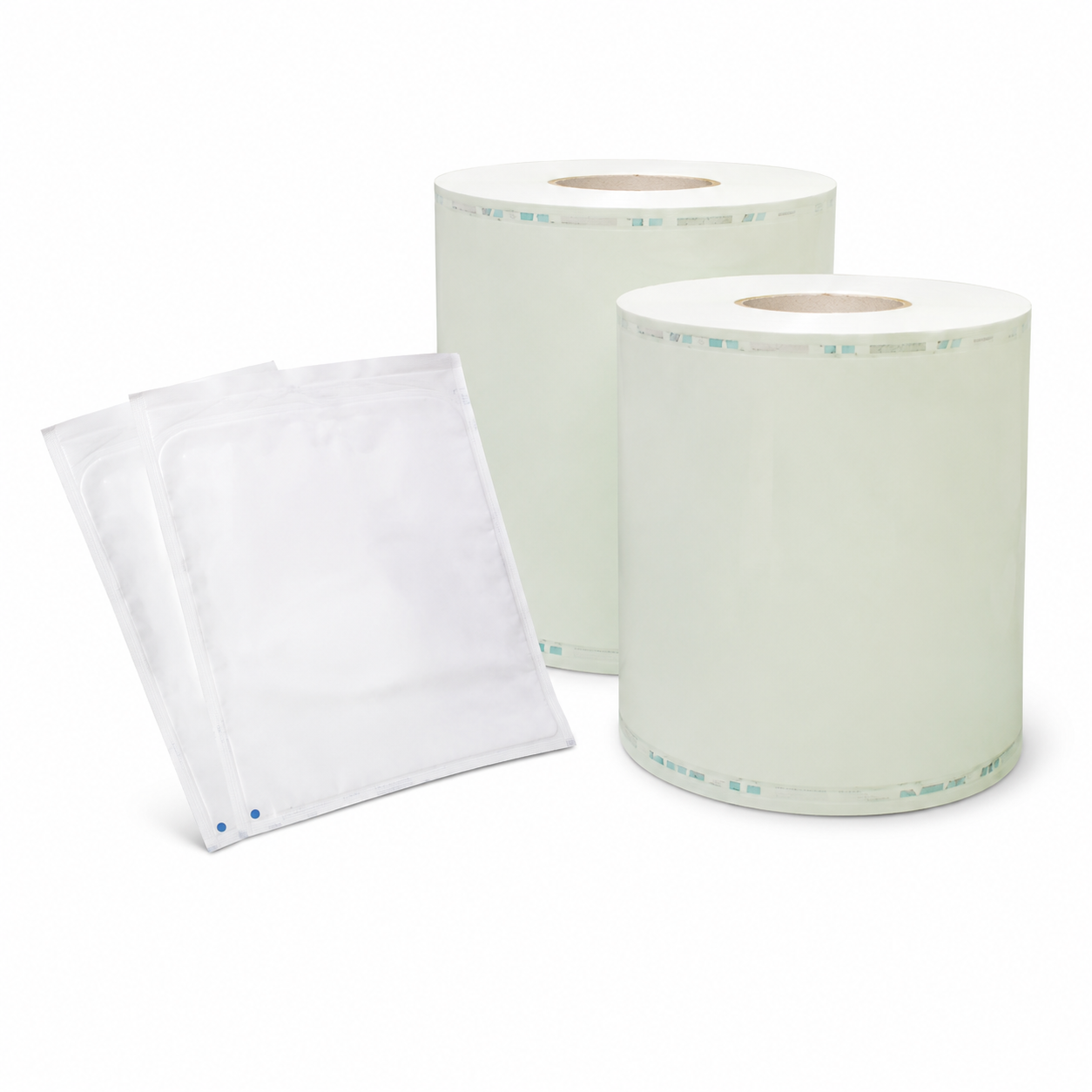
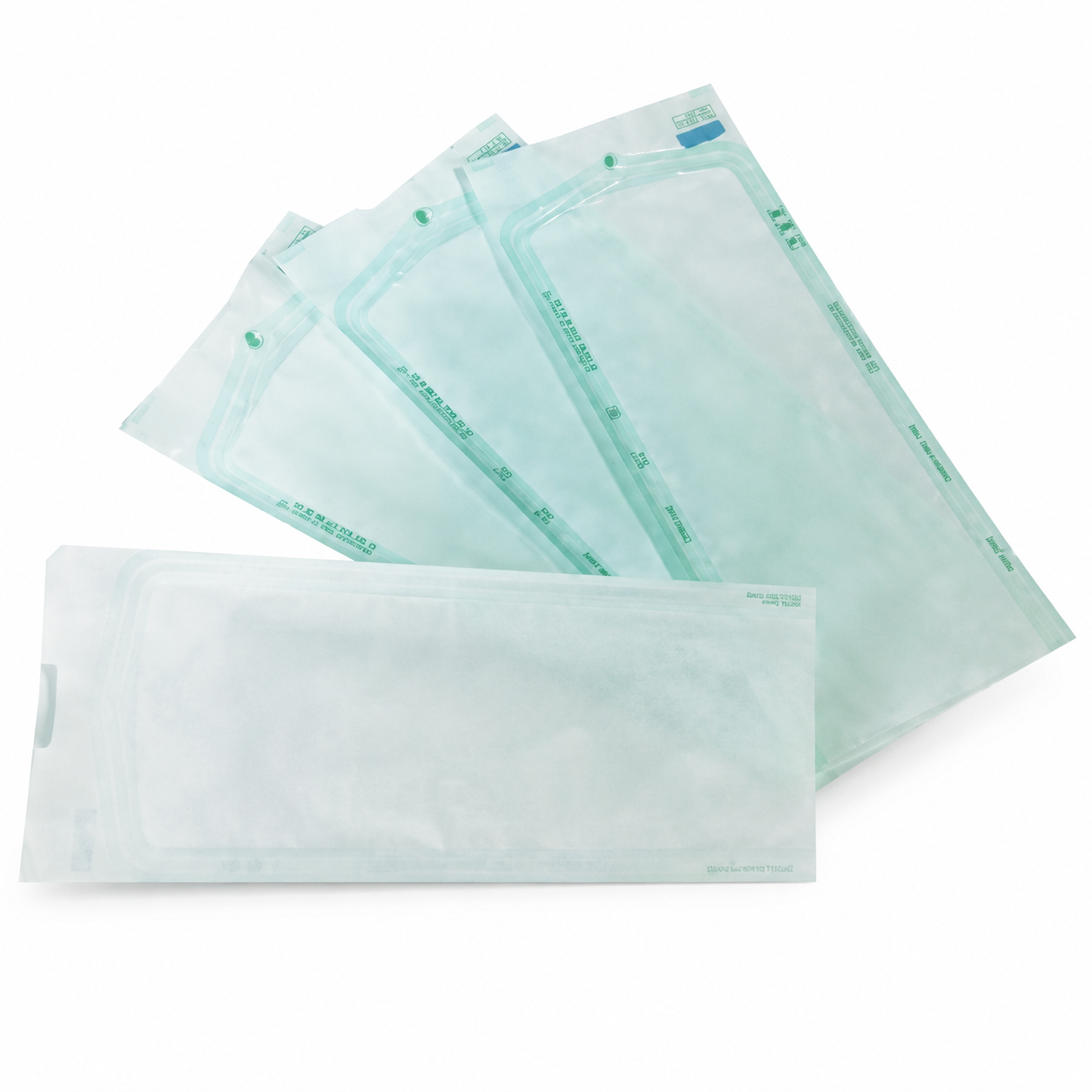
Pouches and reels are the workhorses of any CSSD, used for individually packed instruments and small sets. They share a common construction: a transparent film laminate bonded to medical-grade paper. The film lets staff inspect contents and read indicators; the porous paper allows steam or ethylene oxide to penetrate and then escape, achieving sterilization without trapping moisture.
The Self-Sealing Pouch (MS3612) carries a pre-applied adhesive strip under a peel-off liner. Staff load the instrument, remove the liner and press the flap closed, no sealing machine required. This is ideal for clinics, dental practices and smaller CSSDs where throughput is modest and capital equipment is limited. The Heat-Sealing Pouch (MS3622) has an open end designed for a validated heat sealer, producing a continuous, machine-controlled seal that is preferred in high-volume hospital CSSDs because seal strength and width are reproducible and verifiable.
The Gusseted Pouch (MS3732) adds expandable side or bottom gussets so the pouch can accommodate bulkier instruments and trays without stressing the seals. The Sterilization Roll (MS3722) is supplied as a continuous flat or gusseted reel that CSSD staff cut to length and seal at both ends, giving maximum flexibility for items of unusual size while minimizing waste. The Sterilization Paper Bag (MS3631) is an all-paper, film-free option used where transparency is not required and a lower-cost, fully breathable bag suffices, often for lightweight items processed by steam.
Material Construction and Sterilization Compatibility
Not every package is compatible with every sterilization method, and matching the two correctly is a procurement responsibility as much as a clinical one. Paper-film pouches and paper bags are engineered primarily for steam (moist heat) sterilization and for ethylene oxide (EO), where the porous paper face permits sterilant ingress and air or steam removal. The film side is typically a polyester/polypropylene or polyester/polyethylene laminate selected to withstand autoclave temperatures without delaminating.
Gamma irradiation, by contrast, is generally used by manufacturers for pre-sterilized single-use products rather than in hospital CSSDs, and it can degrade certain polymers and papers over time, so packaging intended for gamma must be specified as such. When buying, always confirm in writing which sterilization modalities a given pouch, roll or wrap is validated for. A common and costly error is to assume a steam-rated pouch is automatically suitable for EO or low-temperature hydrogen peroxide processes, which it may not be.
The sterile barrier system is only as reliable as the weakest match between material, sterilization method and sealing process. Validate all three together, never in isolation.
Chemical Indicators and Sterilization Indicator Tape
Sterilization assurance relies on indicators, and procurement teams should understand the ISO 11140 classification of chemical indicators from Class 1 through Class 6. Class 1 process indicators simply distinguish processed from unprocessed packs; they are the printed indicators found on pouches and the function served by Sterilization Indicator Tape (MS3511/MS3512/MS3513), which secures wrapped packs and changes color to confirm exposure to the steam, EO or other cycle. Higher classes, multi-variable Class 4, integrating Class 5 and emulating Class 6 indicators, are placed inside packs to verify that critical process parameters were met.
Many JPS pouches and rolls carry both steam and EO process indicators printed directly on the film, so staff get an immediate at-a-glance confirmation. When sourcing indicator tape, confirm the modality (steam versus EO tapes differ), adhesion that holds during the cycle yet peels cleanly afterward without residue, and clear, unambiguous color change. The three MS3511/MS3512/MS3513 references typically reflect different widths or indicator chemistries, so specify exactly which you require.
Sterilization Wraps: SMS, Crepe and Laminated Paper
Trays and large instrument sets are wrapped rather than pouched. Here the choice is between non-woven and paper wraps. SMS Wrapping Sheet (MS3425) is a three-layer spunbond-meltblown-spunbond non-woven that combines strength, drape and an effective microbial barrier with good repellency. It is increasingly preferred for heavy or sharp sets because it resists tearing and tenting, and it offers a soft, low-linting surface that supports aseptic presentation in the OR.
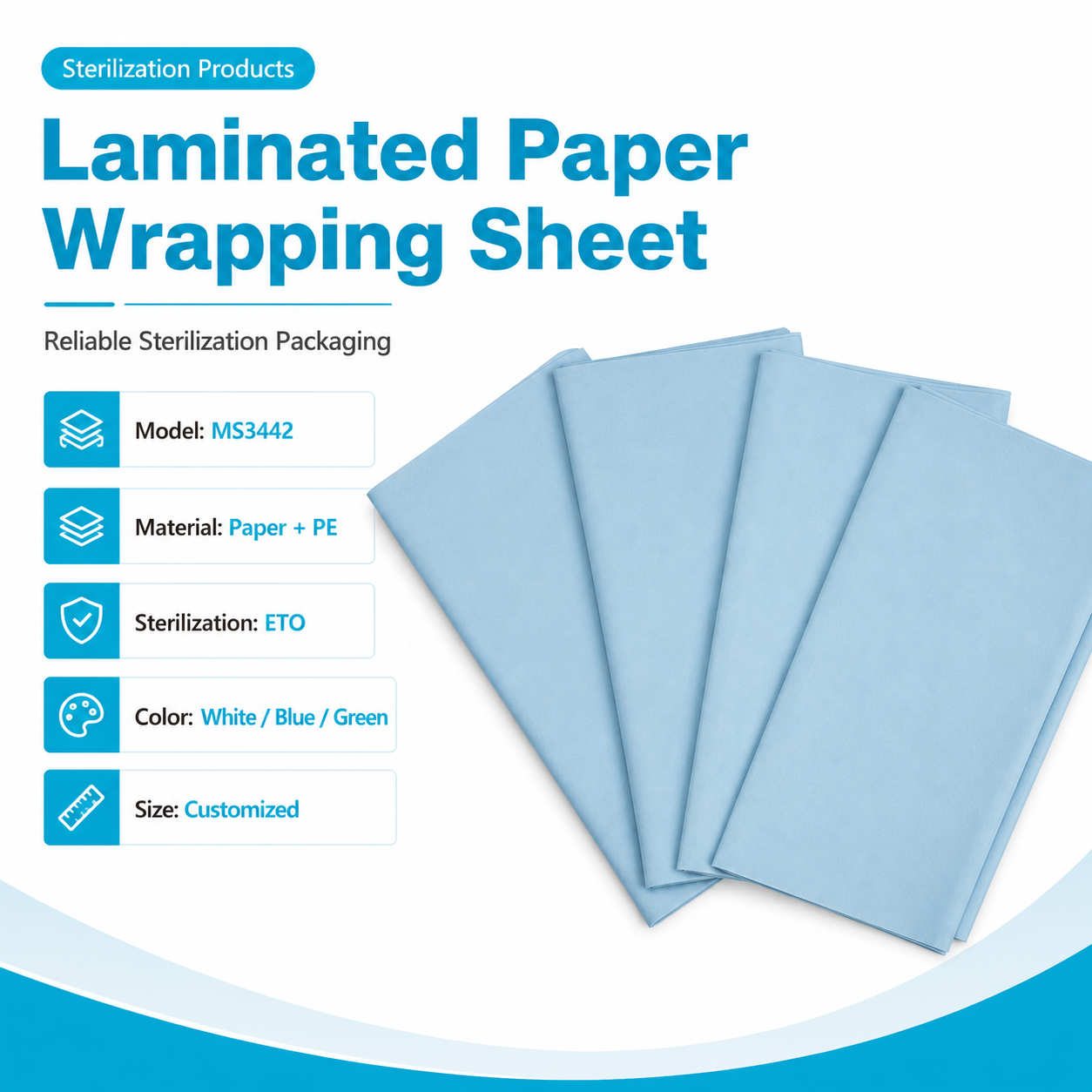
Wrapping Crepe Paper (MS3441) is a traditional creped medical paper valued for its conformability and economy; the crepe structure gives it stretch so it hugs irregular trays. Laminated Paper Wrapping Sheet (MS3442) bonds layers for added strength and barrier performance, bridging the gap between economical crepe and premium non-woven. Best practice for both wrap families is sequential double wrapping (two sheets) or a single bonded two-ply sheet, applied with either the envelope or square fold, to create the redundancy that protects sterility during opening.
Sizing, Shelf Life and Event-Related Sterility
Correct sizing reduces both waste and risk. Pouches and rolls should leave adequate headspace so contents do not stress the seal, and gusseted formats should be chosen when item depth would otherwise balloon a flat pouch. Wraps must be sized to allow a proper fold sequence with sufficient overlap. Most CSSDs standardize on a small matrix of sizes to simplify inventory while covering the majority of sets.
On shelf life, modern infection-control practice has largely shifted from time-related to event-related sterility. The principle is that a package remains sterile until an event compromises it, a tear, a wetting, a broken seal, a dropped pack, rather than until an arbitrary expiry date. ISO 11607 supports this by requiring that the packaging system maintain sterility under defined storage and handling conditions. Procurement should nonetheless confirm validated maximum storage periods and ensure printed lot and process information supports traceability.
| Product | Code | Construction | Primary use | Typical sterilization |
|---|---|---|---|---|
| Self-Sealing Pouch | MS3612 | Paper-film, adhesive strip | Single instruments, clinics | Steam, EO |
| Heat-Sealing Pouch | MS3622 | Paper-film, open end | High-volume CSSD | Steam, EO |
| Gusseted Pouch | MS3732 | Paper-film, side/bottom gusset | Bulky instruments | Steam, EO |
| Sterilization Roll | MS3722 | Flat or gusseted reel | Cut-to-length flexibility | Steam, EO |
| Sterilization Paper Bag | MS3631 | All-paper, film-free | Lightweight items | Steam |
| SMS Wrapping Sheet | MS3425 | Spunbond-meltblown-spunbond | Heavy/sharp tray sets | Steam, EO |
| Crepe Paper Wrap | MS3441 | Creped medical paper | Economical tray wrap | Steam, EO |
| Laminated Paper Wrap | MS3442 | Bonded multi-layer paper | Reinforced tray wrap | Steam, EO |
| Indicator Tape | MS3511/12/13 | Pressure-sensitive, indicator ink | Securing wrapped packs | Steam / EO variants |
Procurement, Certification and Validation
A technically correct product is only half the decision; the supplier behind it matters just as much. Before placing a purchase order, confirm the following with JPS Medical or any prospective vendor:
- Quality system: ISO 13485 certification for the manufacturing site, with current certificates available for review.
- Standards conformity: Documented compliance with ISO 11607 Parts 1 and 2 and the relevant EN 868 parts, plus CE marking for EU-bound goods and appropriate FDA registration or clearance for the US market.
- Material and process validation: Evidence of seal strength testing, peelability, dye penetration and microbial barrier data, along with the supplier's own forming and sealing process validation.
- Quality control and AQL: Inspection sampling to a defined AQL, with traceable lot numbers, batch records and certificates of conformity per shipment.
- Commercial terms: Minimum order quantities by SKU, production lead times, and agreed Incoterms (commonly FOB or CIF for sea freight) so landed cost and transit risk are understood up front.
- OEM and private label: Availability of custom printing, sizing and branded packaging for distributors building their own product lines.
For importers and distributors, the most durable supplier relationships come from those who treat documentation as a deliverable, not an afterthought. Request samples, run them through your customers' actual sterilizers, and confirm performance before committing to volume. The marginal cost of validation is trivial against the cost of a recalled or compromised sterile load.
Key Takeaways
- Match packaging to the CSSD workflow: self-seal pouches for low-volume sites, heat-seal and rolls for high-throughput hospitals, gusseted formats for bulky items.
- Confirm sterilization compatibility (steam, EO, and only where specified, gamma) for every pouch, roll, bag and wrap before buying.
- Use the right indicators: Class 1 process indicators and indicator tape (MS3511/12/13) externally, higher-class chemical indicators inside packs.
- Choose wraps by need: SMS (MS3425) for heavy sets, crepe (MS3441) for economy, laminated paper (MS3442) for reinforced barrier; always double-wrap.
- Adopt event-related sterility, supported by ISO 11607, EN 868, and validated storage conditions.
- Vet suppliers on ISO 13485, CE/FDA status, AQL-based QC, MOQ, lead time, Incoterms and OEM/private-label capability.
Need a quote on Sterilization Products?
Tell us your target quantity and destination — our B2B team replies within one business day with factory-direct pricing, lead time and OEM options.