
Choosing the Right Surgical Gown: AAMI Levels 1–4 Explained
Surgical gowns are deceptively simple-looking products that sit at the center of one of the most heavily regulated categories in the medical disposables market. For distributors, importers, and hospital procurement teams, the single most common purchasing error is treating "surgical gown" as one commodity rather than a graded family of barrier garments. A gown that is perfect for a routine outpatient procedure can be dangerously inadequate for a long orthopedic case, and a gown rated for the operating table may be needlessly expensive for a clinic dressing change. The framework that resolves this is the AAMI PB70 classification system, which sorts gowns into four liquid-barrier performance levels. Understanding those levels & how they map to real procedures is the foundation of every defensible procurement decision in this category.
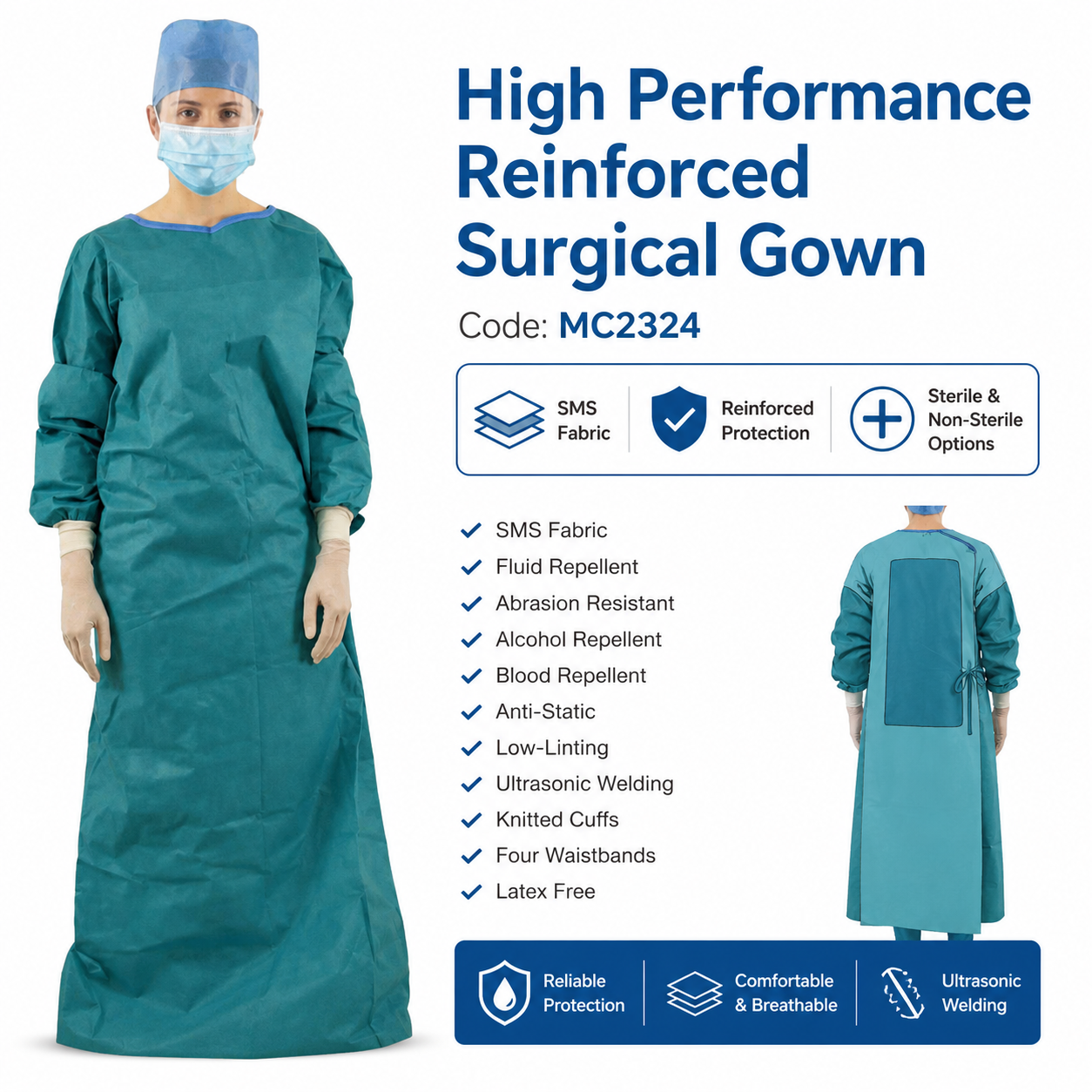
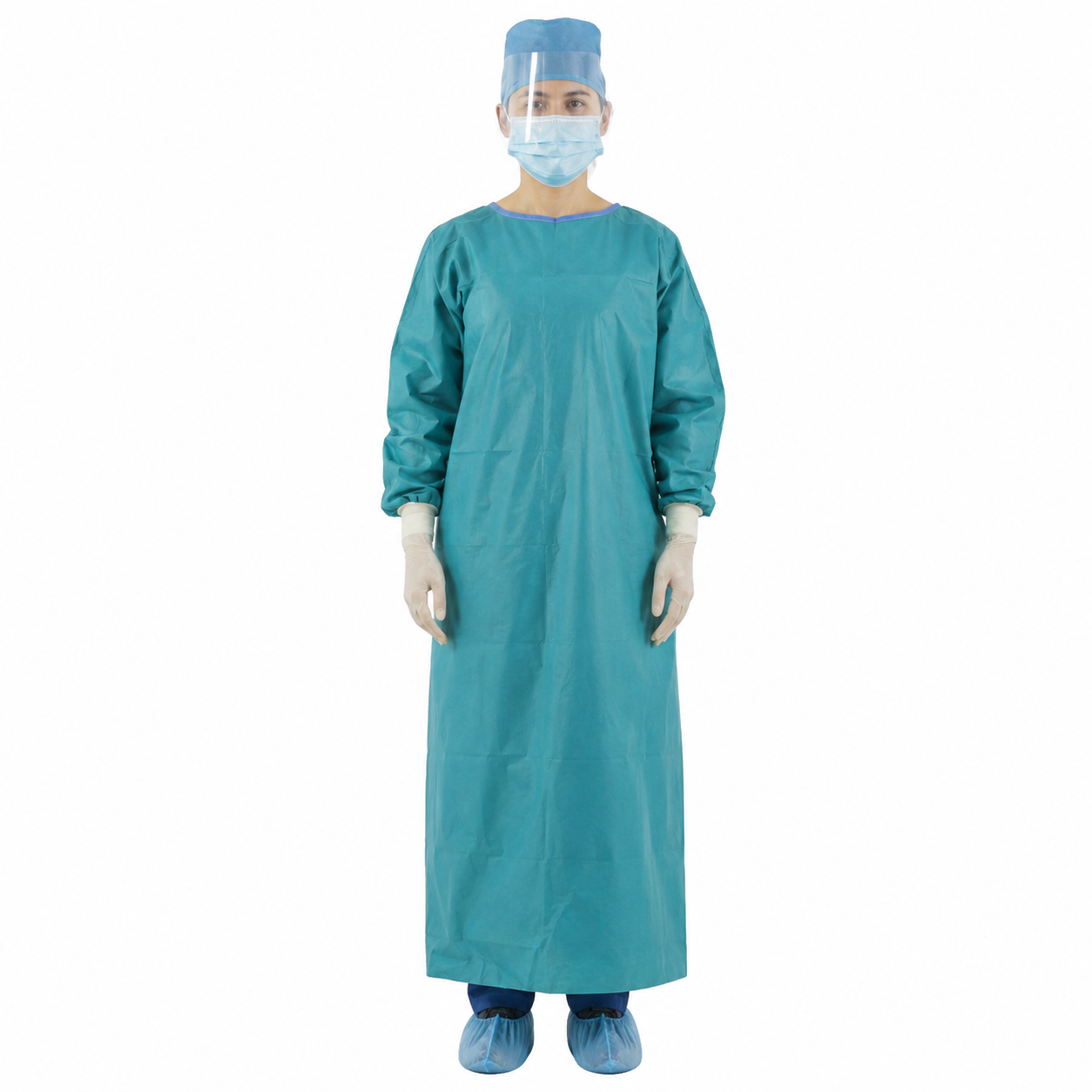
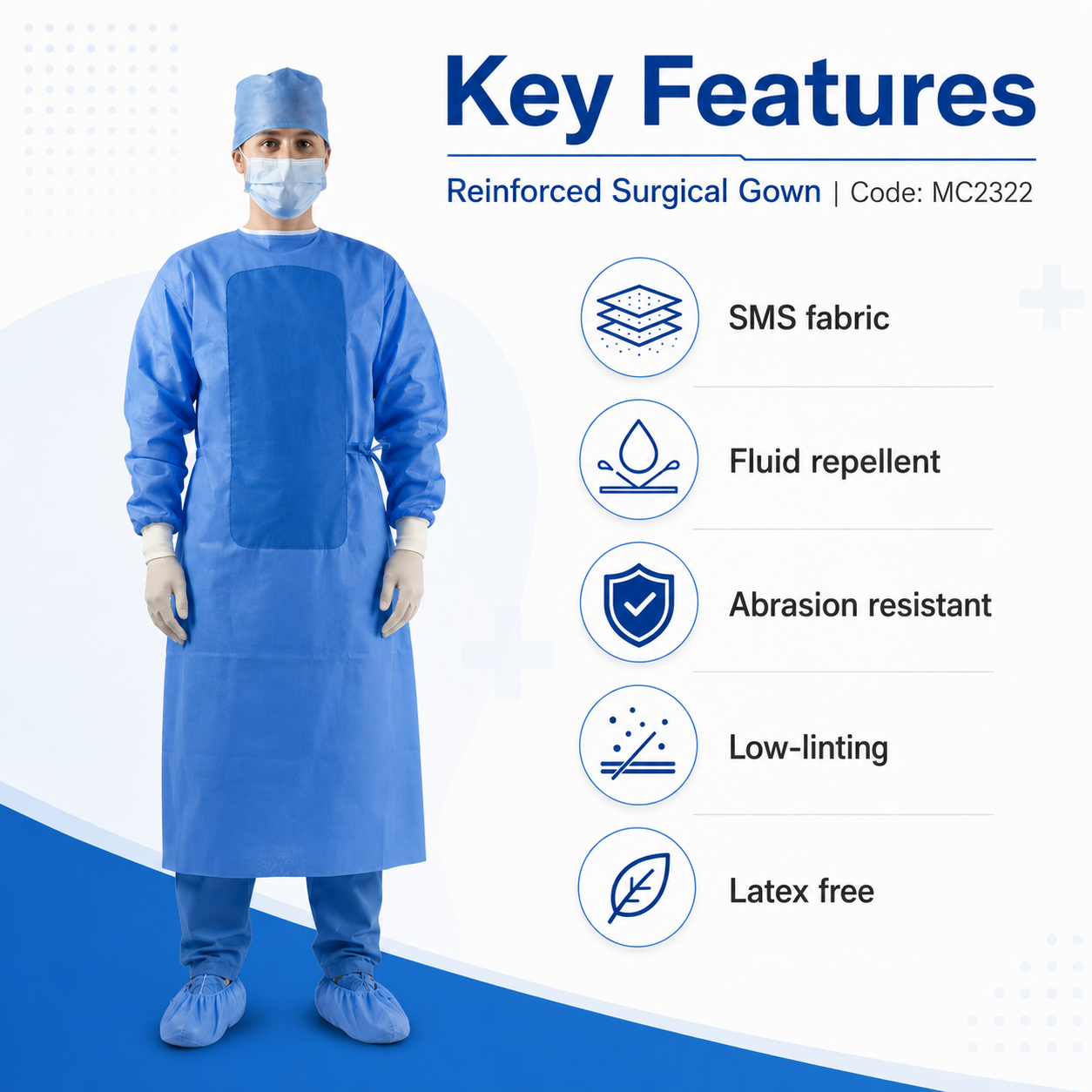
This guide walks through the AAMI PB70 levels, the fabrics that achieve them, the difference between reinforced and standard constructions, sterile versus non-sterile supply, the European EN 13795 standard, and the practical details of sizing, cuffs, and packaging. Throughout, we reference the JPS Medical gown range — the Standard Surgical Gown_MC2321, Reinforced Surgical Gown_MC2322, High Performance Standard Surgical Gown_MC2323, and High Performance Reinforced Surgical Gown_MC2324 — to show how the abstract standards translate into specific stock-keeping decisions.
The AAMI PB70 Framework: Four Levels of Liquid Barrier
ANSI/AAMI PB70 is the American national standard that classifies the liquid barrier performance of surgical gowns, surgical drapes, isolation gowns, and other protective apparel. It does not describe a single garment; it defines a graded test regime that places a product into one of four levels. The critical concept buyers must internalize is that the level reflects barrier performance in the "critical zones" of the gown — the areas most likely to come into contact with blood and fluids, namely the front of the body from chest to knees and the sleeves from cuff to roughly the elbow.
The four levels are defined by progressively more demanding tests:
- Level 1 — Minimal barrier. Tested using the AATCC 42 water impact test. Suitable for basic care and standard isolation where exposure to fluid is minimal.
- Level 2 — Low barrier. Tested with both AATCC 42 (impact) and AATCC 127 (hydrostatic pressure). Appropriate for low-fluid procedures such as minor suturing or work in a pathology lab.
- Level 3 — Moderate barrier. Tested with the same two methods at more demanding thresholds. Indicated for procedures involving moderate fluid volumes, such as arterial blood draws or many general surgeries.
- Level 4 — Highest barrier. Critical zones are tested with ASTM F1671, a viral penetration challenge using a bacteriophage surrogate. Level 4 gowns resist penetration by blood-borne pathogens under pressure and are intended for long, fluid-intensive, or high-risk surgical procedures.
Two points routinely trip up new importers. First, Level 4 is not simply "a stronger Level 3" — it is tested by a fundamentally different method (viral penetration rather than hydrostatic pressure), which is why a supplier cannot informally "upgrade" a Level 3 gown to Level 4 without the corresponding test report. Second, the level applies to critical zones; the back of many surgical gowns is a non-critical zone and may use a lighter material, which is entirely compliant and normal.
Fabrics: SMS, SMMS, and the Role of Meltblown Layers
The barrier level a gown achieves is a direct function of its fabric construction. The dominant materials in modern disposable surgical gowns are spunbond-meltblown-spunbond (SMS) and spunbond-meltblown-meltblown-spunbond (SMMS) nonwovens made from polypropylene. The outer spunbond layers provide tensile strength and abrasion resistance, while the inner meltblown layer (or layers) is the true filtration and barrier medium: its fine, randomly oriented fibers create a tortuous path that resists liquid and microbial penetration.
Adding a second meltblown layer — moving from SMS to SMMS — increases barrier performance and is one of the ways a gown reaches the higher PB70 levels in its critical zones. The basis weight of the fabric, expressed in grams per square meter (gsm), is another lever: heavier fabrics generally provide a more robust barrier and better drape but cost more and are warmer to wear. When evaluating a quotation, ask the supplier to specify both the construction (SMS vs SMMS) and the gsm of each zone, not just the headline AAMI level.
Comfort and breathability matter clinically because a surgeon who is overheated or fatigued is a real risk. Higher-level gowns frequently use a film-laminated or multi-layer reinforced panel in the critical zones for impermeability, paired with a more breathable SMS body for comfort. This is the design logic behind the distinction between standard and reinforced gowns in the JPS range.
Standard vs Reinforced Construction
Within a given gown family, "reinforced" refers to the addition of an extra impervious layer — typically a poly film laminate — bonded over the chest and forearm critical zones. The Standard Surgical Gown_MC2321 and Reinforced Surgical Gown_MC2322 illustrate the difference: the standard version relies on the base nonwoven for its barrier, while the reinforced version adds laminated panels for higher fluid resistance and added abrasion protection during long cases where instruments and the patient repeatedly contact the gown front.
The "High Performance" designation on the MC2323 and MC2324 indicates a more advanced fabric system and finishing — better drape, improved breathability, and consistent critical-zone barrier performance — aimed at facilities that want premium comfort alongside compliance. The decision between standard and reinforced should be driven by procedure type and expected fluid exposure, not by price alone:
Match the gown to the worst-case fluid exposure of the procedure, not the average case. The cost difference between a standard and a reinforced gown is trivial compared with the cost of a single barrier failure in the operating room.
| AAMI Level | Barrier & Test Method | Typical Procedures | Indicative JPS Option |
|---|---|---|---|
| Level 1 | Minimal; AATCC 42 | Basic care, standard isolation, low-fluid clinic work | Standard Surgical Gown_MC2321 (entry config) |
| Level 2 | Low; AATCC 42 & 127 | Minor suturing, pathology lab, low-fluid procedures | Standard Surgical Gown_MC2321 |
| Level 3 | Moderate; AATCC 42 & 127 (higher thresholds) | Many general surgeries, arterial draws, moderate fluid | Reinforced Surgical Gown_MC2322 / MC2323 |
| Level 4 | Highest; ASTM F1671 viral penetration | Long orthopedic, trauma, fluid-intensive, high-risk surgery | High Performance Reinforced Surgical Gown_MC2324 |
The table is indicative: the actual level any given SKU achieves depends on its as-built configuration and must be confirmed against the supplier's test reports. Always request the specific AAMI PB70 classification report for the exact item code and fabric you intend to buy.
EN 13795 and the European Pathway
Buyers serving European or EU-aligned markets should understand EN 13795, the harmonized European standard for surgical gowns, drapes, and clean-air suits. Rather than mirroring the four AAMI levels directly, EN 13795 specifies performance requirements for characteristics such as resistance to microbial penetration (wet and dry), liquid penetration, bursting strength, and linting, and it distinguishes between "standard performance" and "high performance" products as well as critical and less-critical product areas.
For a CE-marked surgical gown sold in the EU, EN 13795 compliance is typically the backbone of the technical documentation supporting conformity under the Medical Device Regulation. Importers should not assume that an AAMI PB70 Level 4 gown automatically satisfies EN 13795 high-performance requirements, or vice versa — the test batteries differ. Where a product is intended for both US and EU markets, request documentation against both standards. A capable manufacturer will hold dual test reports for its premium lines such as the MC2324.
Sterile vs Non-Sterile, Sizing, Cuffs, and Packaging
Surgical gowns are supplied either sterile or non-sterile, and the distinction is procedural, not cosmetic. A gown worn at the sterile field in the operating room must be supplied sterile — most commonly sterilized by ethylene oxide (EO) or gamma irradiation — and presented so that the wearer and a circulating nurse can don it without contaminating the outer surface. Non-sterile gowns are appropriate for isolation and non-invasive settings. When a gown is supplied sterile, its packaging must comply with ISO 11607, the standard governing packaging for terminally sterilized medical devices, which addresses sterile barrier system integrity, shelf life, and the validation of forming, sealing, and assembly processes.
Sizing typically follows a small/medium/large/XL or numeric system, and many surgical gowns are produced in a generous, one-size-leaning cut to accommodate gowning over scrubs. Knit cuffs — usually spandex or polyester — are standard at the wrist because they create a snug seal that keeps the sleeve in place under sterile gloves; the glove cuff is pulled over the knit cuff to complete the barrier. Closure systems include neck and waist ties and a tab-and-card mechanism that lets the wearer complete the wrap-around back closure aseptically. When sourcing, confirm cuff material, tie configuration, and whether a sterile gown is supplied with the appropriate transfer card and folding for aseptic donning.
Packaging and shelf life
For sterile product, ask for the validated shelf life (commonly several years), the sterilization method and its validation, and confirmation that the sterile barrier system has been validated per ISO 11607. For EO-sterilized gowns, residual EO must be within accepted limits. For non-sterile bulk gowns, confirm carton counts, inner-bag protection against moisture, and clear lot labeling for traceability.
Procurement Checklist: What to Request from Suppliers
Translating standards knowledge into a clean purchase requires disciplined supplier qualification. Before placing an order, request and verify the following:
- Quality system: A current ISO 13485 certificate covering medical device manufacture, plus the manufacturer's CE technical file references and, where relevant, FDA establishment registration or 510(k) status for the US market.
- Barrier classification reports: AAMI PB70 level reports (and ASTM F1671 for Level 4) and/or EN 13795 reports for the exact item code and fabric configuration — not a generic family certificate.
- Sterilization documentation: Method, validation, EO residual limits where applicable, and ISO 11607 packaging validation for sterile lines.
- Specification sheet: Fabric construction (SMS/SMMS), gsm per zone, sizing chart, cuff and closure details, and AQL sampling plan used for finished-goods inspection.
- Commercial terms: MOQ, lead time, OEM/private-label capability, and Incoterms.
On commercial terms, expect MOQs that vary by configuration — standard non-sterile lines such as the MC2321 generally carry lower MOQs than fully sterile, reinforced, OEM-printed configurations. Typical production lead times for established lines run several weeks and extend when sterile processing or custom private-label packaging is involved. JPS Medical supports OEM and private-label programs across the MC2321–MC2324 range, including custom sizing, branded packaging, and carton marking. Clarify Incoterms early: many buyers prefer FOB or CIF for sea freight, while smaller or urgent orders may move under air freight terms. Whatever the Incoterm, agree the pre-shipment inspection protocol — including the AQL level for critical, major, and minor defects — in writing before production starts, so that finished-goods quality is verifiable rather than assumed.
Key Takeaways
- AAMI PB70 grades surgical gowns into Levels 1–4 by liquid-barrier performance in critical zones; Level 4 is uniquely tested by ASTM F1671 viral penetration.
- Barrier performance comes from fabric construction — SMS vs SMMS and gsm — with reinforced laminated panels added in critical zones for higher-risk procedures.
- Match the gown to the worst-case fluid exposure of the procedure: MC2321 for low-fluid work up to the MC2324 for fluid-intensive surgery.
- For EU markets, verify EN 13795 separately from AAMI PB70; request dual test reports where both markets are served.
- Confirm sterile vs non-sterile supply, ISO 11607 packaging validation, cuff and closure details, and full sizing data.
- Qualify suppliers on ISO 13485, item-specific barrier reports, MOQ, lead time, OEM/private-label scope, Incoterms, and a written AQL inspection plan.
Need a quote on Surgical Gowns?
Tell us your target quantity and destination — our B2B team replies within one business day with factory-direct pricing, lead time and OEM options.