
Syringes and Needles: Sizes, Safety Features and Bulk Sourcing
Few medical disposables move in the volumes that syringes and needles do, and few carry as much regulatory and safety weight per gram of plastic and steel. From routine intramuscular injections to insulin delivery, wound irrigation and intravenous access, these devices touch nearly every patient interaction. For distributors, importers and hospital procurement teams, the difficulty is not in finding a supplier — it is in specifying the right configuration, verifying compliance with the international standards that govern dimensions and safety, and securing a supply chain that delivers consistent, sterile, well-documented product at scale. This guide covers the practical engineering and sourcing decisions behind syringes and needles: two-part versus three-part construction, Luer fittings, volumes, specialty syringes, needle gauge and length, butterfly sets, sharps safety, and the certification and procurement terms that protect a buyer's programme.
Two-part vs Three-part Syringes
The most fundamental distinction in disposable syringes is construction. A two-part syringe consists of a barrel and a plunger only; the plunger tip is the same polypropylene as the rod, with no separate rubber seal. Two-part designs are economical and have no rubber-latex contact concerns, but the seal relies on a tight plastic-to-plastic fit, which can make the plunger movement less smooth and the seal less forgiving. A three-part syringe adds a separate rubber (often synthetic, latex-free) gasket on the plunger tip. This rubber piston glides smoothly, seals reliably and gives the controlled, low-friction action clinicians associate with a quality injection. The Syringe (MD2772 / MD2773) range covers these mainstream configurations across the common volumes used in everyday clinical practice.
For most clinical markets, three-part syringes are preferred for their smooth, accurate delivery, while two-part syringes serve cost-sensitive applications and certain veterinary or non-critical uses. When sourcing, confirm whether the rubber piston is latex-free (important for allergy management and many tender specifications) and whether the syringe is supplied with or without an attached needle.
Luer Slip vs Luer Lock
The connection between syringe and needle — or between syringe and an IV line, catheter or irrigation tip — follows the internationally standardised Luer taper. There are two variants. A Luer slip tip relies on a simple friction push-fit: fast to connect and disconnect, ideal for quick injections. A Luer lock tip adds a threaded collar that screws onto the needle hub or connector, mechanically locking the two together. Luer lock is strongly preferred where pressure is involved or where an accidental disconnection would be hazardous — high-pressure injection, irrigation, infusion and any situation where the connection must not pop off. Distributors should stock both, and procurement should specify the variant per clinical area rather than defaulting to one.
Specify the tip — slip or lock, central or eccentric — on the purchase order. A correct syringe with the wrong Luer fitting is the wrong syringe, and it is one of the most common avoidable mismatches in a bulk order.
Volumes, Insulin and Irrigation Syringes
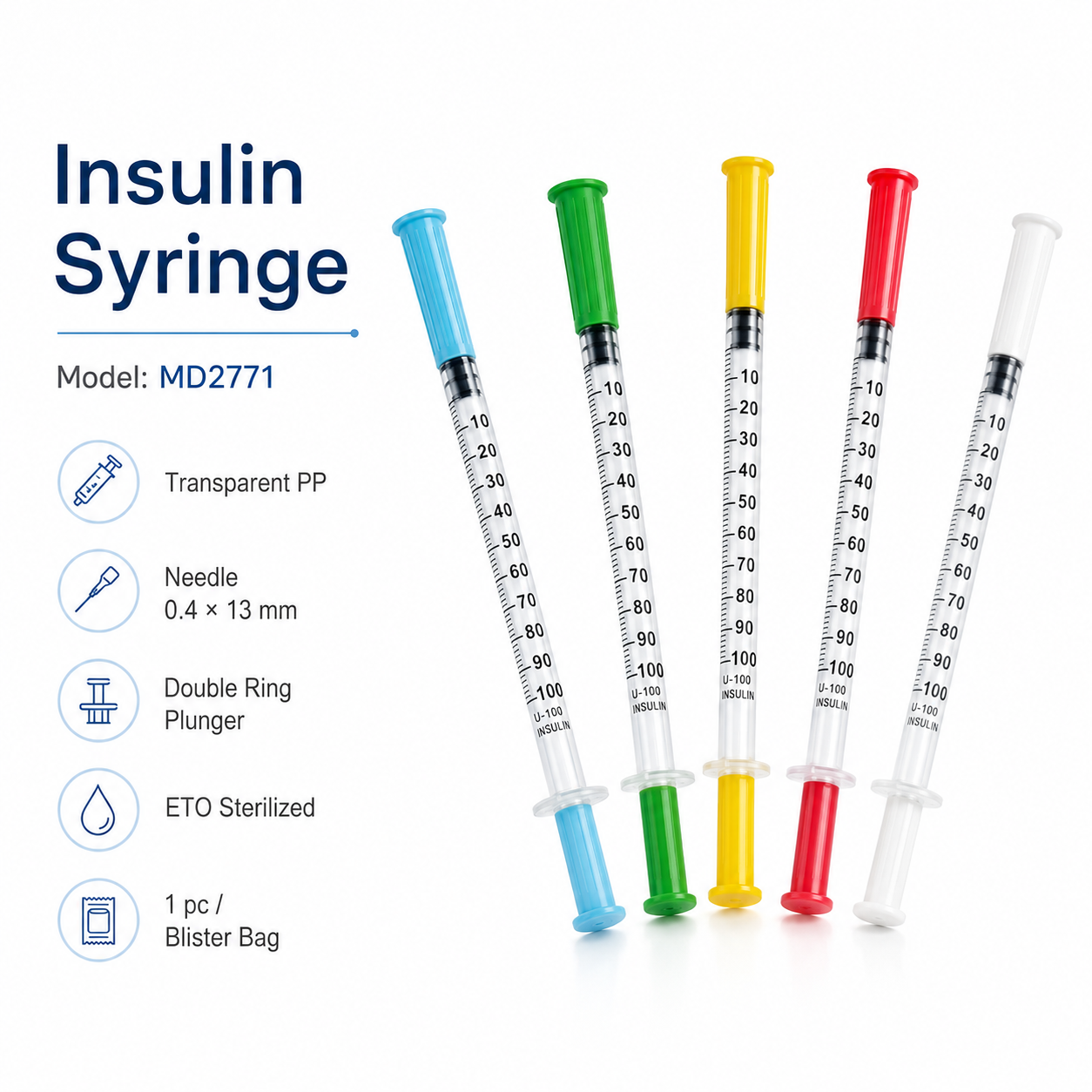
Standard hypodermic syringes are offered in graduated volumes — 1 mL, 2/3 mL, 5 mL, 10 mL, 20 mL and larger — with clear, durable scale printing that must not smear or wash off. Two specialty configurations deserve separate attention. The Insulin Syringe (MD2771) is a fine-gauge, low-dead-space syringe graduated in insulin units rather than millilitres, designed for U-100 insulin (100 units per mL). The unit graduations must align precisely with the U-100 standard, the needle is typically fixed and very fine to reduce injection discomfort, and dead space is minimised so the full measured dose is delivered. Accuracy here is not a convenience feature — it is the whole point of the device.
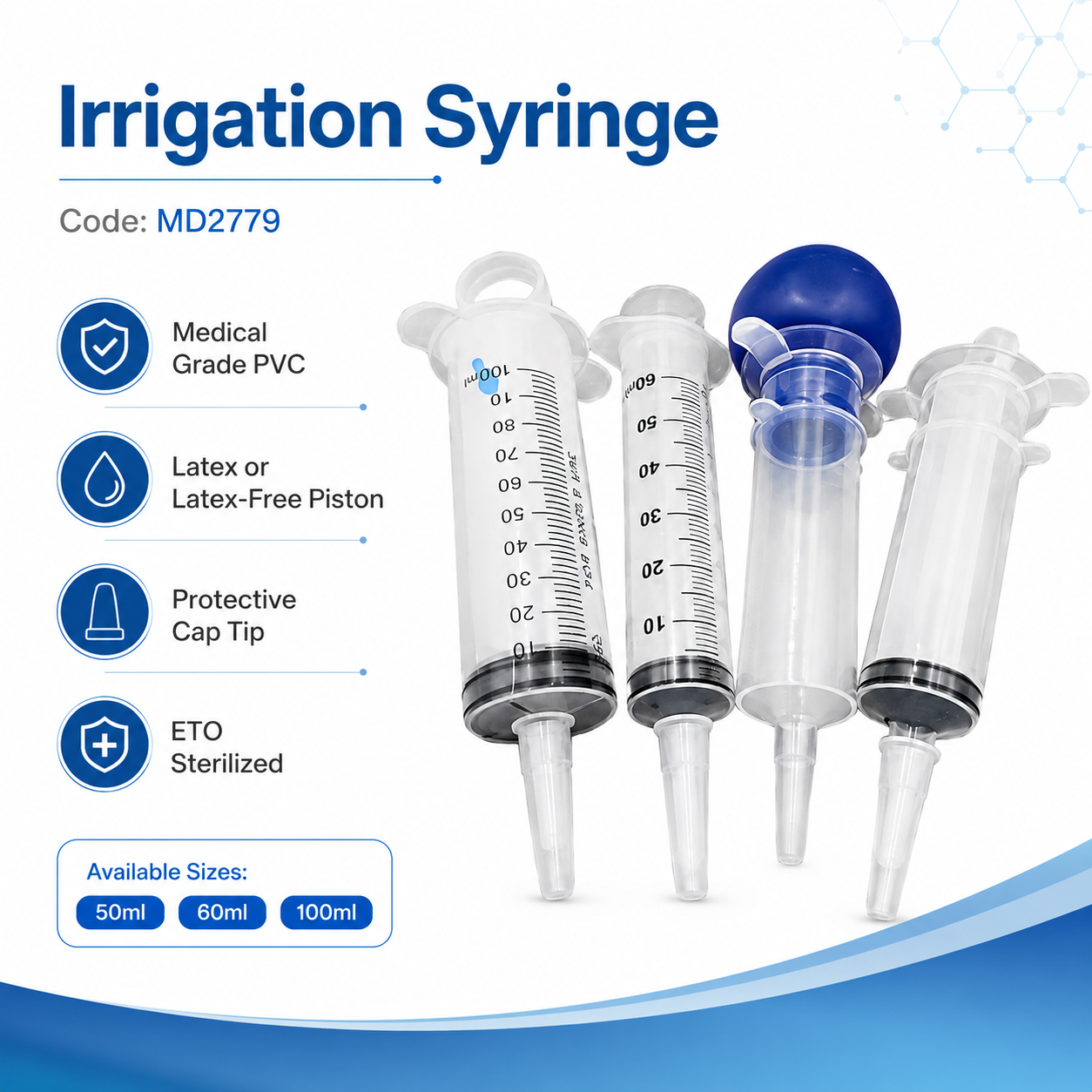
The Irrigation Syringe (MD2779) is a large-volume syringe (commonly 50/60 mL) used for wound irrigation, flushing, feeding and aspiration rather than injection. It often features a catheter tip or a large Luer fitting and a robust plunger for high-flow delivery. Because irrigation generates back-pressure, a secure tip and a smooth, non-sticking plunger are essential. These are non-injection devices, but they share the same sterility and material expectations as injectable syringes.
Needle Gauge, Length and Scalp Vein Sets
The Hypodermic Needle (MD2782) is defined by two numbers: gauge and length. Gauge is the outer-diameter scale — counter-intuitively, a higher gauge number means a thinner needle (a 30G needle is far finer than an 18G). Length is stated in millimetres or inches. The right combination depends on the route and patient: fine, short needles for intradermal and subcutaneous injection; longer, larger-bore needles for intramuscular injection or drawing up viscous medication. Needle dimensions, colour-coding of the hub by gauge, tip geometry and stiffness are governed internationally so that a "21G" needle from one compliant maker matches a "21G" from another.
The Scalp Vein Set CMSV (MD2770) — the "butterfly" or winged infusion set — pairs a short, fine needle with flexible plastic wings and a length of tubing ending in a connector. The wings make the needle easy to grip, insert at a shallow angle and tape down securely, which is why butterfly sets are favoured for difficult veins, paediatric and elderly patients, and short infusions or blood draws. Quality markers include a sharp, smoothly bevelled needle, well-bonded wings, kink-resistant tubing and a secure connector.
| Gauge (G) | Approx. outer diameter | ISO hub colour | Typical use |
|---|---|---|---|
| 18G | 1.27 mm | Pink | Drawing up, viscous fluids, IM |
| 21G | 0.81 mm | Green | Routine IM, blood draw |
| 23G | 0.64 mm | Blue | IM/SC, paediatric |
| 25G | 0.51 mm | Orange | Subcutaneous, fine injection |
| 27G | 0.41 mm | Grey | Intradermal, dental, fine SC |
| 30G | 0.31 mm | Yellow | Insulin, very fine injection |
Safety, Sharps and Needlestick Prevention
Needlestick injuries are a serious occupational hazard and a major regulatory focus worldwide. Safety-engineered devices — needles and syringes with retractable mechanisms, hinged shields or sliding sleeves that cover the needle after use — are increasingly mandated or preferred in tenders, particularly in the EU and US healthcare systems. Even where conventional devices are supplied, the design must support safe single-use: a needle hub that locks firmly so it cannot detach unexpectedly, a clear sharp bevel, and packaging that allows aseptic presentation. Distributors should understand which destination markets require safety features and should be able to offer compliant options where end users demand them.
Single use is non-negotiable for these devices. Reuse risks cross-infection and dose inaccuracy, so syringes and needles are supplied sterile, individually packed and clearly marked single-use with a "do not reuse" symbol and an expiry date. Sterile barrier integrity — an intact peel pouch or blister — is the user's assurance that the device inside is safe; any compromised packaging means the device is discarded.
Standards: ISO 7886, ISO 9626 and Sterilisation
Two ISO standards anchor the specification of these products. ISO 7886 covers sterile hypodermic syringes for single use, setting requirements for dead space, graduation accuracy, plunger force, the Luer fitting and freedom from leakage — with specific parts addressing insulin syringes and power-driven syringes. ISO 9626 specifies stainless-steel needle tubing for the manufacture of medical devices, defining tube dimensions, wall thickness and mechanical strength so that needle gauge and stiffness are consistent and reliable. Asking a supplier to confirm conformity to ISO 7886 (syringes) and ISO 9626 (needle tubing) gives procurement an objective compliance baseline rather than relying on marketing language.
Sterilisation of syringes and needles is overwhelmingly by ethylene oxide (EO), which is well suited to assembled plastic-and-steel devices in their final packaging; gamma irradiation is used for some components. Whichever method is used, the buyer should receive evidence of a validated sterilisation process, residual EO limits within accepted thresholds, and a defined shelf life. Lot numbers and expiry dates must be printed on the unit and shipping packaging for traceability and recall capability.
Procurement, Certification and QC
When sourcing syringes and needles in bulk from a China-based manufacturer such as JPS Medical, the documentation and commercial terms are as important as the device specification. Procurement should confirm the following before committing to an order:
- Certification: ISO 13485 (and EN ISO 13485) quality management certification, CE marking under the EU MDR for EU placement, and FDA registration/510(k) status where the device is sold in the US. Request ISO 7886 and ISO 9626 conformity evidence and sterilisation validation reports.
- MOQ and lead time: high-volume injection devices typically support efficient MOQs; confirm production lead time plus freight transit so stock planning accounts for the full supply chain.
- OEM / private label: printed barrels, pouches and cartons in the buyer's brand and destination-market language, with correct regulatory symbols and unit-of-measure conventions (mL and insulin units must be unambiguous).
- Incoterms: agree FOB, CIF or DDP explicitly to define who bears freight, insurance and customs clearance.
- QC and AQL: agree an inspection plan with Acceptable Quality Limits covering critical defects (leakage, blocked needles, non-sterile packaging, graduation error), major defects and minor cosmetic defects, with the right to pre-shipment inspection.
The economics of injection devices are unforgiving of quality failures: a syringe that leaks, a needle that detaches, or a sterile pouch that arrives compromised can stop a clinic, fail a tender or trigger a recall. Specifying to ISO 7886 and ISO 9626, insisting on validated EO sterilisation, and locking down certification, OEM, Incoterms and an AQL plan transforms a commodity purchase into a dependable, defensible supply programme.
Key Takeaways
- Choose three-part syringes (MD2772/MD2773) for smooth, accurate delivery and two-part for cost-sensitive uses; confirm latex-free pistons.
- Specify Luer slip vs Luer lock per clinical area — lock is essential under pressure and for irrigation and infusion.
- Insulin Syringe (MD2771) must match the U-100 standard with precise unit graduations and minimal dead space; Irrigation Syringe (MD2779) needs a secure tip and smooth high-flow plunger.
- Match needle gauge and length (MD2782) to route and patient; rely on ISO hub colour coding, and use butterfly Scalp Vein Sets (MD2770) for difficult veins.
- Verify ISO 7886 (syringes), ISO 9626 (needle tubing), validated EO sterilisation, single-use labelling and an AQL-based QC plan, alongside ISO 13485, CE and FDA documentation.
Need a quote on Syringes and Needles?
Tell us your target quantity and destination — our B2B team replies within one business day with factory-direct pricing, lead time and OEM options.