
Wound Care Essentials: Gauze, Swabs and Dressings for Distributors
Wound care consumables are the quiet workhorses of every hospital ward, surgical theatre, ambulance kit and pharmacy shelf. They are also among the highest-volume, fastest-turning lines a medical distributor can carry, which makes getting the specification, certification and supply chain right far more important than the modest unit price suggests. For importers and procurement teams, the challenge is rarely "can we find gauze" — it is finding gauze, swabs and dressings that arrive with consistent ply, reliable absorbency, traceable raw cotton and documentation that satisfies a tender committee or a regulatory auditor. This guide walks through the core categories — woven cotton gauze, non-woven swabs, laparotomy sponges, gauze rolls, absorbent cotton wool, cotton balls and cotton buds — and the practical sourcing decisions that separate a profitable, complaint-free programme from a returns headache.
Woven Cotton Gauze vs Non-woven Swabs
The first decision in any wound-care catalogue is the substrate. Traditional Gauze Swabs (MB2366) are woven from cotton yarn into an open-mesh fabric, then cut and folded so the raw edges are tucked inward to minimise loose threads (lint) that could be left in a wound. The defining specifications are thread count and ply. Thread count is expressed as threads per square inch or per 10 cm — common clinical grades run from 17×13 up to 30×26 or higher, with denser weaves offering greater strength and absorbency at higher cost. Ply refers to the number of folded layers: 4-ply, 8-ply, 12-ply and 16-ply are the everyday sizes, with 8-ply 7.5×7.5 cm and 10×10 cm being the most-requested SKUs worldwide.
Non-woven Swabs (MB2303) are made from bonded polyester/viscose blends rather than woven cotton. Because the fibres are entangled rather than knitted, non-woven swabs produce far less lint, are softer, drape better around contours, and are frequently more absorbent per gram than equivalent woven gauze. They are popular for cleaning, prepping and light exudate management. The trade-off is that some clinicians and tenders still specify cotton for tradition, cost or perceived "natural" handling. A well-rounded distributor stocks both and lets the end user choose; many hospital systems now run non-woven for routine cleaning and reserve woven cotton for packing and heavier absorption.
A swab is only as good as its weakest edge. Loose threads, inconsistent folding and lint are the most common reasons a wound-care line gets flagged in clinical use — specify edge treatment and lint limits in your purchase order, not just size and ply.
X-ray Detectable Lap Sponges and Surgical Use
Lap Sponges (MB2466) — laparotomy sponges or "abdominal pads" — are large, highly absorbent woven pads used to soak up blood and fluid and to pack body cavities during surgery. Their single most important feature is the X-ray detectable element: a barium sulphate-impregnated radiopaque thread or marker woven into every sponge, plus a sewn loop tape, so any sponge retained in a patient can be located radiographically and counted reliably. For any surgical line, confirm that the radiopaque thread is continuous and securely anchored, that the loop tape is firmly stitched, and that sponges are supplied in sterile, count-verified packs (commonly packs of 5) to support surgical counting protocols. Pre-washed lap sponges shed less lint and are generally preferred for cavity use.
Gauze Rolls, Cotton Wool, Balls and Buds
Beyond flat swabs, the rolled and formed cotton products complete the wound-care shelf. Gauze Roll (MB2566) — rolled conforming or plain gauze bandage — is used to wrap, secure and pad. It is sold by width (5 cm, 7.5 cm, 10 cm, 15 cm) and unstretched length, and the key quality markers are even winding, consistent width and freedom from holes or thin patches. Absorbent Cotton Wool (MB24650) is bulk carded cotton supplied in rolls or pleated packs (BP/USP "absorbent cotton"); it must sink readily in water within the time the pharmacopoeia specifies, demonstrating that natural waxes have been removed and the cotton is genuinely absorbent rather than merely white.
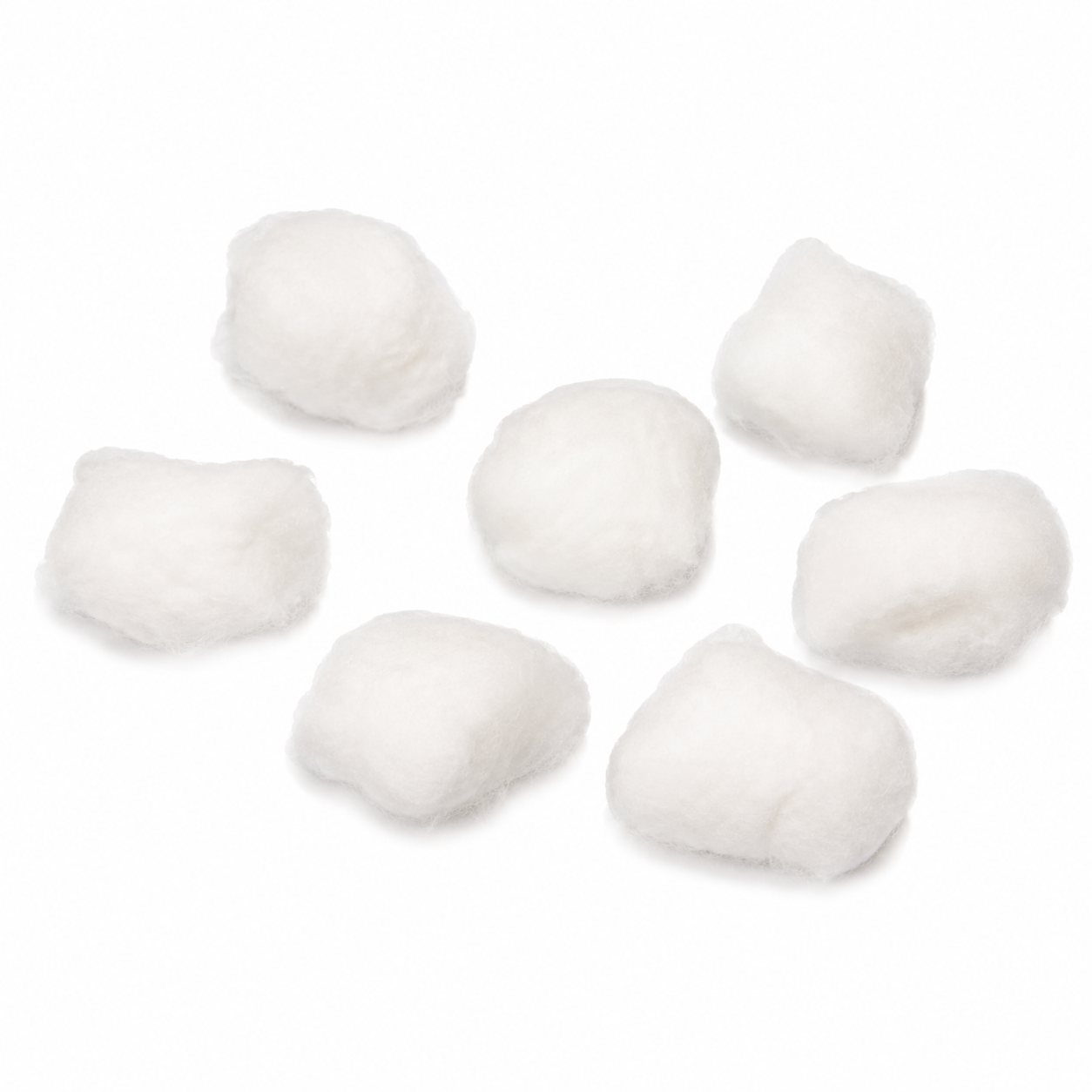
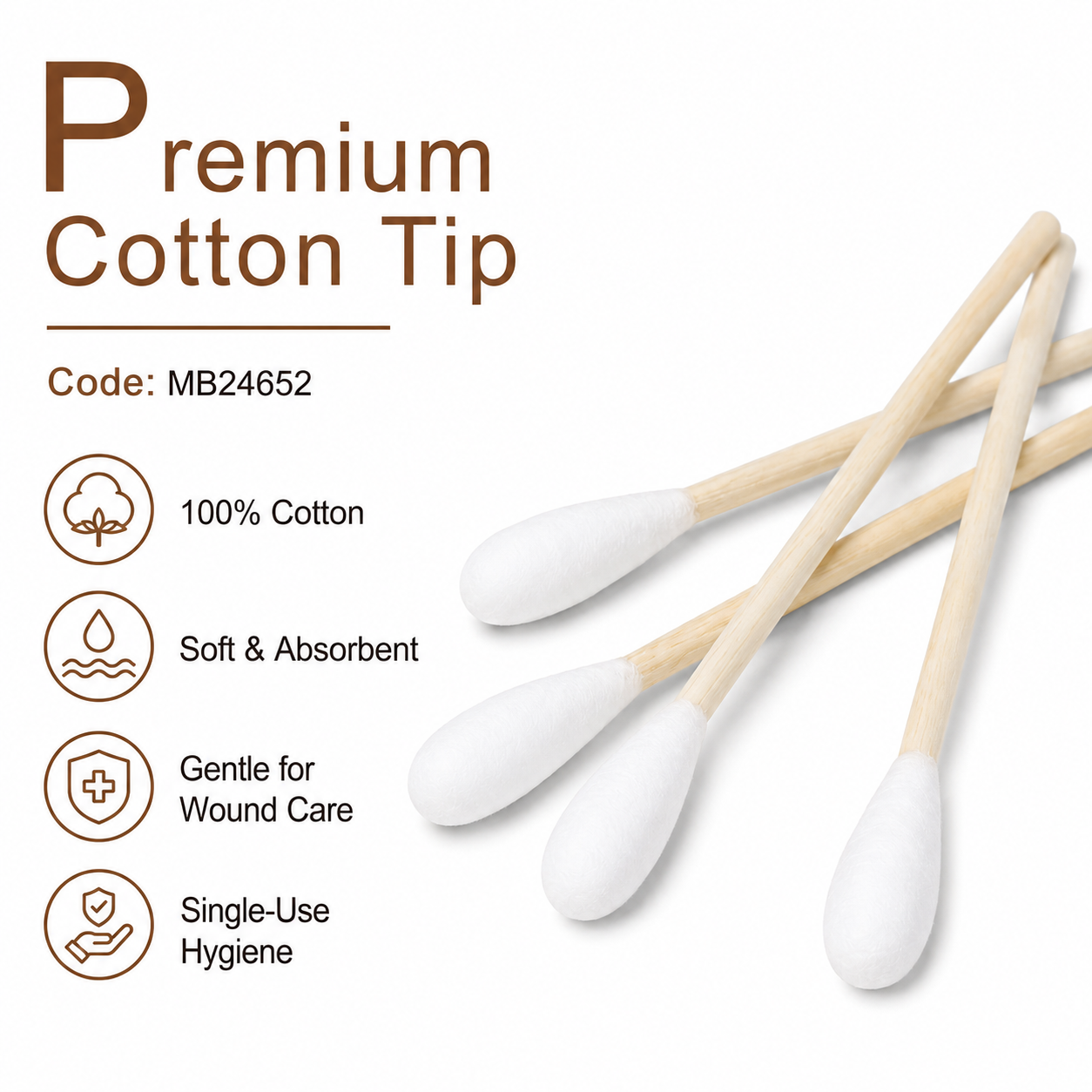
Cotton Balls (MB24651) are formed spheres for applying antiseptic, prepping skin and dabbing, available in sterile and non-sterile grades and in several weights. Cotton Buds (MB24652) — medical swab sticks — use a paper, wood or plastic stick tipped with cotton at one or both ends, for cleaning small areas, applying solutions and specimen handling. Medical-grade buds should have securely bonded tips that do not detach in use. Across all of these, distributors should distinguish clearly between cosmetic-grade and medical-grade products: medical lines demand controlled raw cotton, defined absorbency and, where labelled sterile, validated sterilisation.
Sterile vs Non-sterile and Absorbency (EN 14079)
Whether a product is sterile or non-sterile drives both its clinical use and its regulatory burden. Non-sterile gauze and cotton are acceptable for general cleaning away from open wounds and for secondary dressings; sterile products are required where the item contacts an open wound, surgical site or sterile field. Sterile medical disposables are typically processed by ethylene oxide (EO) or gamma irradiation, individually or pack-wrapped in validated peel pouches, and labelled with a sterilisation method, lot number and expiry. Confirm sterility assurance level documentation and shelf life before importing.
Performance for absorbent gauze and cotton products is addressed by EN 14079, the European standard covering non-active medical devices made of cotton and viscose gauze and cotton wool. It defines requirements and test methods for properties such as mass per unit area, absorbency (sinking time and water absorption capacity), thread count and pH. Asking a supplier for EN 14079 test data — rather than a generic "high absorbency" claim — gives procurement an objective basis for comparison and a defensible answer if a tender or auditor questions quality.
| Product | Common sizes | Typical grade / ply | Sterile option | Standard reference |
|---|---|---|---|---|
| Gauze Swabs (MB2366) | 5×5, 7.5×7.5, 10×10 cm | 17×13 to 30×26, 4–16 ply | Yes (EO/gamma) | EN 14079 |
| Non-woven Swabs (MB2303) | 5×5, 7.5×7.5, 10×10 cm | 30–50 gsm, 4 ply | Yes | EN 14079 (where applicable) |
| Lap Sponge (MB2466) | 30×30, 45×45 cm | X-ray detectable, pre-washed | Yes (pack of 5) | Surgical count protocol |
| Gauze Roll (MB2566) | 5, 7.5, 10, 15 cm width | Plain / conforming | Yes / No | EN 14079 |
| Absorbent Cotton Wool (MB24650) | 25 g to 500 g rolls | BP/USP absorbent cotton | No (typical) | BP / USP |
| Cotton Ball (MB24651) | 0.3–0.5 g spheres | Medical grade | Yes / No | BP / USP |
| Cotton Bud (MB24652) | Single / double tip | Paper/plastic/wood stick | Yes / No | — |
Raw Cotton Quality, Sizing and Packaging
Every cotton wound-care product begins with raw cotton, and the quality of that fibre cannot be fully corrected downstream. Long-staple, well-cleaned cotton scoured and bleached to remove natural waxes yields the soft, lint-controlled, fast-wetting product clinicians expect. Short-staple or under-processed cotton produces lint, slow absorbency and grey-tinged colour. Reputable manufacturers control incoming fibre, monitor whiteness, pH and absorbency, and can show batch records. When evaluating a supplier, ask how they verify absorbency (sinking time), how they control pH to skin-neutral ranges, and whether finished goods are tested against EN 14079 or pharmacopoeial methods.
Sizing and packaging are where many disputes arise. Folded sizes should be stated as folded dimensions, and any size tolerance agreed in writing. Specify count per pack, packs per inner box, boxes per carton, carton dimensions and weight, and whether printing is in the buyer's language. For sterile lines, confirm pouch material, seal integrity and the printed expiry format. Clear, agreed packaging specifications prevent the "the boxes are a different size than last shipment" complaints that quietly erode margins through re-labelling and customer goodwill.
Procurement, Certification and QC
For distributors, importers and hospital procurement, the commercial and quality terms matter as much as the product itself. The baseline expectation from a credible China-based manufacturer such as JPS Medical is a quality management system certified to ISO 13485 (and EN ISO 13485 for the EU), CE marking under the EU Medical Device Regulation where the product is placed on the EU market, and FDA registration/listing for the US market where applicable. Sterile products should carry sterilisation validation records, and absorbent products should be supported by EN 14079 or pharmacopoeial (BP/USP) test data.
Practical commercial points to settle before placing an order:
- Certification pack: ISO 13485 certificate, CE documentation, FDA registration where relevant, product test reports and a Certificate of Conformity per shipment.
- MOQ and lead time: high-volume commodities like gauze and cotton wool usually carry achievable MOQs; confirm production lead time (often a few weeks) plus sea-freight transit when planning stock.
- OEM / private label: printed pouches, boxes and cartons in your brand and language, with regulatory text appropriate to the destination market.
- Incoterms: agree FOB, CIF or DDP explicitly so responsibility for freight, insurance and customs is unambiguous.
- QC and AQL: agree an inspection plan with defined Acceptable Quality Limits for critical, major and minor defects (loose threads, missing radiopaque markers, seal failures, wrong counts), and reserve the right to a pre-shipment inspection.
Treating wound-care consumables as a specified, documented product line — rather than an interchangeable commodity bought on price alone — is what protects a distributor's reputation. The unit cost is small; the cost of a tender failure, a clinical complaint or a customs hold over missing documentation is not.
Key Takeaways
- Woven gauze (MB2366) offers traditional strength; non-woven swabs (MB2303) offer low lint and softness — stock both and specify ply, thread count and edge treatment.
- Lap sponges (MB2466) must have continuous X-ray detectable thread, sewn loop tape and count-verified sterile packs for surgical safety.
- Use EN 14079 and BP/USP test data to verify absorbency, mass and pH objectively for gauze rolls (MB2566), cotton wool (MB24650), balls (MB24651) and buds (MB24652).
- Distinguish sterile (EO/gamma, validated, dated) from non-sterile lines, and match each to its clinical use.
- Lock down certification (ISO 13485, CE, FDA), MOQ, lead time, OEM/private-label, Incoterms and an AQL-based QC plan before ordering.
Need a quote on Wound Dressing?
Tell us your target quantity and destination — our B2B team replies within one business day with factory-direct pricing, lead time and OEM options.